
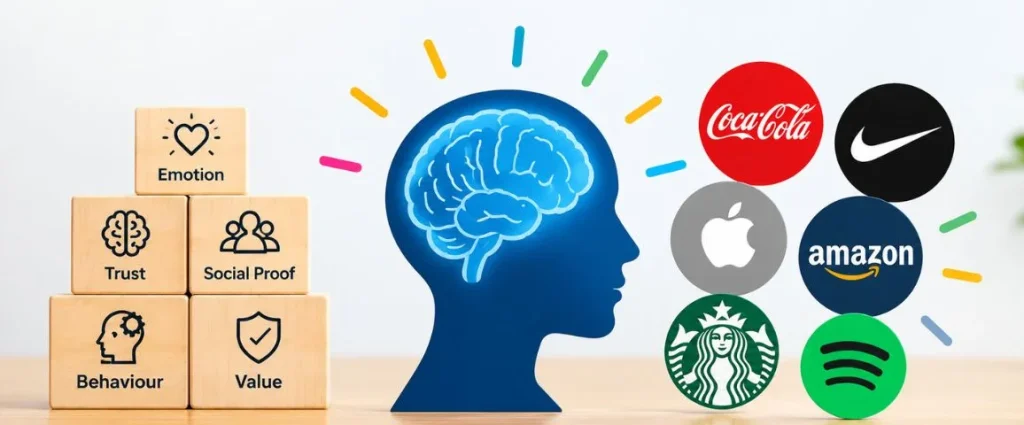
Consumer psychology in marketing is mainly about understanding why people buy, trust, remember, compare, share, or ignore a brand. Customers may compare prices and features, but the majority of the decisions are not based on logic alone.
People tend to respond to emotions, identity, convenience, habit, trust, urgency, social proof, and the feeling that a brand understands them.
That is why marketing not only explains a product. It also makes the customer feel something before they arrive at a decision. A brand can also use personalisation, rewards, scarcity, community, confidence, and simplicity to influence overall consumer buying behaviour.
So, in this blog, we will be looking at the 10 real-world consumer psychology examples from well-known brands and try to understand what marketers can learn from them.
Quick Look at Consumer Psychology in Marketing
| Brand | Psychology Used | What It Influences |
|---|---|---|
| Coca-Cola | Personalisation | Emotional connection |
| Spotify | Self-expression | Sharing and identity |
| Apple | Trust | Risk reduction |
| Amazon Prime | Convenience | Repeat buying |
| Starbucks | Rewards | Loyalty and habit |
| Zomato | Convenience and cravings | Instant decisions |
| IKEA | Ownership | Product attachment |
| Cadbury Dairy Milk | Ritual and emotion | Sharing and celebration |
| Netflix | Personalisation | Faster decisions |
| Nike | Aspiration | Motivation and identity |
Why Does Consumer Psychology in Marketing Matter?
Consumer psychology in marketing helps brands to understand what happens before a customer clicks, buys, and recommends a product. It also helps in studying the thoughts, emotions, and triggers that help in shaping the purchasing decisions.
As per Nielsen, approximately 83% of the global respondents said that they trust the recommendations from friends and family. This also shows that consumers’ buying behaviour is strongly affected by trust and social influence, and not just advertising.
In addition, the study of consumer behaviour also includes how emotions, attitudes, and preferences affect purchasing decisions. This is why brands use psychology to reduce doubts, build connections, and make choices feel easier.
1. Coca-Cola: Personalisation Through “Share a Coke”
The “Share a Coke” campaign of Coca-Cola is considered to be one of the best examples of personalisation in the realm of marketing. The company substituted its logo on the bottles and cans with popular names and nicknames.
The campaign was reintroduced in 2025, targeting the new generation with an emphasis on the personal aspect and shareability.
The psychology here is obvious. People react promptly to their names. At this point, a regular bottle becomes personalised. Moreover, people buy bottles with the names of their friends and relatives, turning the product into a little social interaction.
Thus, it is a perfect example of consumer psychology in marketing.
Psychology Used: Personalisation, Belonging, and Emotional Connection.
2. Spotify: Self-Expression Through Wrapped
Spotify Wrapped works because it swiftly converts listening data into personal identity. It not only shows what the users listen to. But it also tells them what their music taste says about them.
People share Wrapped as it feels like a digital personality card. It offers users a colourful summary of their mood, habits, and favourite artists. This connection between music preferences, personal identity, and social sharing helps explain why Spotify Wrapped attracts so much attention. Research on Spotify Wrapped and identity offers further insight into this connection.
This affects consumer buying behaviour because people feel more connected to a platform that helps in reflecting their identity. Perhaps Spotify becomes not only a music app but also a space for self-expression.
Psychology Used: Identity, self-expression, and social sharing.
3. Apple: Building Trust Through Privacy Messaging
Apple has managed to build a strong part of its brand around privacy. Even its official page highlights that privacy is a fundamental human right.
This messaging works because today, people are so concerned about their personal data. It goes without saying that technology can be useful, but it can also appear to be risky. But Apple reduces that fear by positioning itself as a brand that protects the user.
When it comes to consumer psychology in marketing, trust is a major trigger point. When people feel safe with a brand, they are more likely to stay loyal and pay a premium.
Psychology Used: Trust, safety, and risk reduction.
4. Amazon Prime: Conversion and Loss Aversion
Here, Amazon Prime uses the psychology of convenience. Customers pay an amount for the membership, and then they receive benefits like fast delivery, entertainment, and special offers.
Once the people have paid for the Prime membership, they will often use the platform more, as they don’t want the membership to get wasted. This is connected with loss aversion, where people try to avoid losing value from something they already paid for.
This is one of the most sought-after consumer psychology examples, as it shows how convenience can create a repeat behaviour pattern. The easier the buying process feels, the higher the probability that the customers will return.
Psychology Used: Convenience, commitment, and loss aversion.
5. Starbucks: Loyalty Through Rewards and Status
Starbucks uses points, benefits, and membership levels to create repeat visits. In 2026, Starbucks introduced a revised loyalty programme with Green, Gold, and Reserve levels.
This works fine as people like progress. When customers earn a star or move towards the next level, a regular coffee purchase appears to be an important part of a much broader picture.
Rewards also help in creating a sense of status. Customers will feel more involved with the brand, as they are not simply purchasing coffee, but they are getting something with every purchase.
Psychology Used: Rewards, progress, status, and habit building.
6. Zomato: Convenience and Food Mood Cravings
Zomato makes use of the psychology of cravings, convenience, and instant gratification. Food decisions are often quick and emotional. People may not always plan what they intend to eat. Sometimes, they simply respond to hunger, mood, comfort, or a craving.
Zomato makes this possible by bringing different restaurant options, ratings, delivery time, and offers all in one place. This, in turn, reduces the customer effort and allows them to act faster.
Moreover, Zomato also uses timely notifications, tempting food visuals, and occasion-based campaigns to connect with the customer’s current mood. This can impact consumer buying behaviour to a great extent, as the platform does not just sell food delivery. But it also responds to what the customer feels in that moment.
Psychology Used: Convenience, craving, and instant gratification.
7. IKEA: Ownership Through Effort
IKEA is linked with the “IKEA Effect”, a psychological concept that explains how people tend to value things more when they help in creating or assembling them.
When customers build IKEA furniture, they invest their efforts. Those efforts help in creating attachment. As a result, the product feels more personal because the customer helped in completing it.
This is one of the most useful consumer psychology examples for product-based brands. Sometimes, the efforts put in by a customer can increase the value rather than reducing it, as long as the final result feels successful.
Psychology Used: Ownership, pride, and effort.
8. Cadbury Dairy Milk: Emotion Through Sharing and Celebrations
Cadbury Dairy Milk has built a strong emotional recall in India by connecting chocolate with sharing, celebration, and small, happy moments that are worth cherishing. Campaigns such as “Kuch Meetha Ho Jaye” helped position the chocolate as something people could enjoy during festivals, achievements, family moments, and everyday occasions.
Here, the psychology is simple. People do not always buy chocolate because they want something sweet. They may buy it to celebrate, gift, share, and make a moment feel warmer.
Therefore, this makes Cadbury Dairy Milk one of the most relatable consumer psychology examples. The brand connects its products with emotions and social rituals rather than only taste.
Psychology Used: Sharing, nostalgia, and emotional connection.
9. Netflix: Personalised Recommendations
Netflix makes use of personalisation to reduce decision fatigue. The platform recommends shows and films that are based on viewing behaviour, preferences, and similar users.
This matters, as too many choices can easily confuse customers. When Netflix organises content around individual taste, it also enables users to decide faster.
Personalisation also helps in shaping customer buying behaviour as it reduces efforts. Customers are more likely to use a service that feels easy, relevant, and familiar.
Psychology Used: Personalisation, ease, and decision support.
10. Nike: Emotion and Self-Belief
Nike’s marketing focuses more on motivation and less on products. In 2025, Nike reintroduced “Just Do It” to a new generation through its “Why Do It” campaign.
Well, Nike does not always sell shoes or sportswear. It also sells the feeling of effort, courage, and self-belief.
Again, this is a powerful example of consumer psychology, as customers are not simply buying a product, but they are buying into an identity. They want to feel stronger, more disciplined, and more capable.
Psychology Used: Aspiration, emotions, and identity.
What These Brand Examples Tell Marketers
These brand examples clearly show that consumer psychology in marketing is not about tricking customers. But it is more about understanding what people feel, fear, want, and value.
Mentioned below are the main lessons for the marketers:
| Psychology Trigger | Marketing Lesson |
|---|---|
| Trust | Reduce doubt before asking for action |
| Personalisation | Make customers feel recognised |
| Rewards | Give people a reason to return |
| Convenience | Remove effort from the buying journey |
| Identity | Help customers see themselves in the brand |
| Social proof | Let people feel supported by others |
| Scarcity | Create urgency without pressuring unfairly |
Wrapping Up
Every successful marketing campaign is built on the proper awareness of what consumers notice, value and recall. The price and features of the product may play their role, yet brands which stick in the consumer’s mind manage to tap into a trigger that goes far beyond price and features, such as trust, convenience, emotional triggers or a sense of identity.
Coca-Cola relies on personalisation. Spotify converts data into identity. Apple relies on trust through privacy concerns. Amazon Prime offers convenience in purchases. Starbucks wins consumers’ loyalty with its rewards program. Zomato acts on cravings and convenience. IKEA creates ownership through involvement. Cadbury Dairy Milk builds a connection between chocolate and sharing celebrations. Netflix eliminates the choice paradox. Nike fuels self-confidence.
The message is clear. Successful brands don’t just sell products; they know people.
Explore how leading brands use consumer psychology to influence buying decisions and discover real-world examples of emotions, trust, and marketing strategies with One Final Draft. Visit our Write for Us page to share your ideas and contribute valuable content.
Frequently asked questions
What is consumer psychology in marketing?
It refers to the mental processes involved before buying goods. Consumer psychology in marketing helps brands understand factors affecting customers’ decisions.
What is the importance of consumer psychology for brands?
Brands are able to make great advertisements, lower doubt levels, increase customers’ trust, and encourage customer loyalty by applying consumer psychology.
What are some examples of consumer psychology?
Personalisation, rewarding, social proof, scarcity, building trust, making things convenient for consumers, appealing emotionally, and loyalty programs are among examples of consumer psychology.
What is the impact of consumer buying behaviour on marketing?
Consumer buying behaviour explains why a customer chooses one product over another. Brands can take advantage of this information in order to develop their marketing strategy.
Comments are coming soon. In the meantime, share this piece with someone who should read it.