

In early 2026, Ahrefs studied 863,000 keywords and 4 million AI Overview citations and discovered that only 38% of the pages cited by Google’s AI also ranked in the top 10 organically, versus 76% just 7 months prior.
This stat says it all. A good Google rank doesn’t guarantee AI will ever mention you. AI search reads sites differently, rewarding clarity rather than cleverness.
Structured data for AI search should be seen as a technical must-have today. That’s the difference between being quoted by an AI and being invisible to it.
How AI Search Actually Works Now?
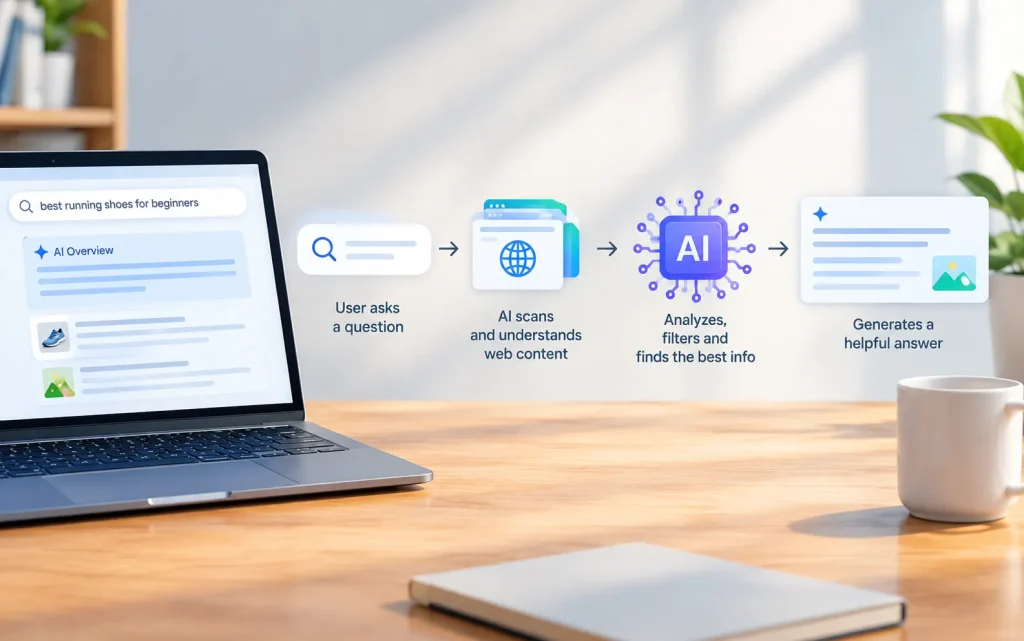
From Ranking Pages to Generating Answers
Google AI Overviews, ChatGPT, Perplexity, Claude, and Copilot don’t simply rank pages. They read the pages, extract facts, and stitch together one answer from trusted sources.
To do that, they need to know what a page is about, what facts are reliable and how those facts relate to real entities.
This is where schema markup earns its keep. Without it, an AI is left guessing whether “4.8” on your page is a rating or a random number. With it, there’s no guesswork.
Why This Changes the Visibility Game
If your site isn’t feeding AI clean, labelled data, it won’t bother interpreting your prose. This gap already shows up in AI search ranking data, where pages with weak markup get quietly dropped from AI answers, even while still ranking fine on Google.
Now for the data behind this shift, let’s move ahead.
The Evidence: What the Data Actually Shows
Citation and Visibility Statistics
71% of pages cited by ChatGPT and 65% cited by Google AI Mode carry structured data for AI search.
As per Milestone Research analysis (the research division of Milestone Inc.), pages with correct schema markup earn up to 58% more rich-result impressions than unmarked pages.
An experiment that ran from December 2025 to March 2026 recorded a 611% jump in Google AI Overview citations after adding schema.
Ahrefs ran its own controlled test of 1,885 pages that added schema versus 4,000 matched controls and found no meaningful citation uplift on ChatGPT or AI Mode, with AI Overviews even dipping slightly.
Schema markup won’t force an AI to cite you, but nearly every large study agrees it makes citation far more likely. Treat AI search optimization as removing friction, not buying a guarantee.
What This Means for Rankings and Clicks
Google says schema doesn’t directly change your position, but it changes how your result looks and behaves. Here is a real edge for your AI search ranking over time:
1. Structured pages get roughly 30% more clicks.
2. Rich results earn a 58% click-through rate versus 41% for standard listings.
3. Clean markup helps crawlers read your site more quickly, so more long-tail content can be considered as an AI answer.
So the numbers are clear. But why does structure earn this much trust from a machine?
Why AI Trusts Structure More
From Keywords to Machine-Readable Facts
Instead of guessing from context, structured data SEO works by giving AI an explicit label for each piece of information on a page.
JSON-LD (JavaScript Object Notation for Linked Data) is a lightweight scripting format for adding structured data (schema markup) to your website. It can tell AI that a page is an article by a named person, that a block is a FAQPage with distinct Q&As, or that a listing is a LocalBusiness with hours and address.
AI systems protect factual accuracy, so they treat clear markup as a confidence signal. A named author gets cited more confidently than anonymous content.
Note that not every AI platform reads schema the same way, so it works best paired with genuinely well-written content. It’s an amplifier, not a replacement.
Content Quality Still Comes First
Structured data SEO won’t save thin, generic content.
A study by Princeton, Georgia Tech, and IIT Delhi tested nine strategies on 10,000 queries and found that adding concrete stats improved AI visibility by about 41%, which is one of the biggest levers measured.
In short, fact-dense writing is the building block, structured data for AI search is the booster, and the biggest winners in AI citations are the sites that combine the two.
The Schema Types That Actually Matter in 2026
Not all schema markup carries equal weight.
Tier 1: Core Types Nearly Every Site Needs
1. Article: Blogs, guides, editorial content
2. FAQPage: Direct Q&A AI can lift almost verbatim (check eligibility rules first)
3. HowTo: Recipes, tutorials, step-by-step content
4. BreadcrumbList: Shows AI your site structure
5. Organisation/Person: Establishes who’s behind the content
Tier 2 and a Simple Stack Pattern
1. For local and commercial sites, LocalBusiness, Product + AggregateRating, and Recipe schema all carry real weight.
2. A strong pattern is Article + Person + Organisation + Breadcrumb or Article + FAQPage, where the post genuinely answers common questions.
3. Pages combining three or more coherent schema types see a noticeably stronger citation rate, which is worth remembering for any AI search optimisation plan.
Choosing the right types is half the job, and keeping the data accurate is the other half.
Keeping Your Structured Data For AI Search Trustworthy
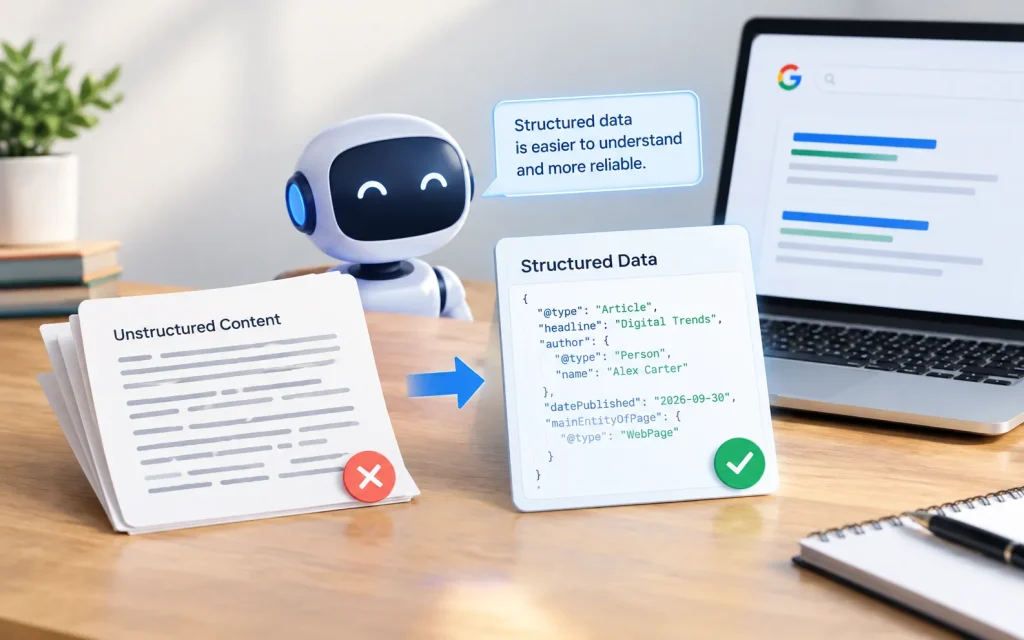
AI systems cross-check facts across sources before citing anything, so your markup needs to match what’s visibly written on the page, your Google Business Profile, and other pages on your site. Mismatches like “schema drift” erode an AI’s confidence, even over minor errors.
Think of this as basic structured data SEO housekeeping: quarterly, audit your schema against live content, alert editors when key facts change, and validate everything with Google’s Rich Results Test and the Schema.org validator before publishing.
If you’re auditing how AI crawlers access your site, it’s worth also checking llms.txt, the web standard that every site needs in 2026. It is a newer file that curates which pages matter most to AI systems. Schema and llms.txt solve different problems, but both feed into the same goal.
Putting It Into Practice
Priorities by Website Type
| Website type | Why it matters | Core schema |
|---|---|---|
| Blogs & content | Gets pulled into AI Overviews and chat answers | Article, FAQPage, HowTo, Breadcrumb |
| Local business | Answers “near me” queries confidently | LocalBusiness, Organisation |
| E-commerce | Lets AI quote price, stock, ratings | Product, Offer, AggregateRating |
| Education | Builds authority for informational queries | Article, Course, FAQPage |
| Multi-location | Keeps details consistent across branches | Organisation, LocalBusiness, Place |
Quick-Start Checklist
Follow this order for a practical AI search optimisation rollout:
1. Audit key pages with Google’s Rich Results Test.
2. Implement Tier 1 types first.
3. Use JSON-LD only. It is Google’s recommended format.
4. Match markup to visible content exactly.
5. Add depth before breadth.
6. Recheck quarterly as part of ongoing structured data SEO maintenance.
The Bottom Line
By mid-2026, AI search is a growing share of how people find information and increasingly shapes AI search ranking outcomes, not just organic ones. Schema-rich pages get cited noticeably more, and thin-structured data increasingly means “indexed but ignored”, even while you still rank fine in classic search.
Every website is competing for a place inside AI-generated answers, not just page one. Getting your structured data for AI search right won’t guarantee a mention, but skipping it all will most certainly guarantee that you won’t get one. That’s too big a risk for your AI search ranking in 2026.
As AI-driven search continues to change how information is discovered, learn more about structured data, AI search visibility, and modern SEO strategies with practical insights from One Final Draft.
Frequently asked questions
What is structured data for AI search?
Structured data is code added to a webpage that helps search engines and AI systems understand its content, entities, relationships, and key information more clearly.
Why is structured data important for AI search in 2026?
Structured data gives search engines clearer information about a page, which can help them interpret and categorize content for AI-powered search experiences.
Does structured data guarantee that a website will appear in AI-generated answers?
No. Structured data does not guarantee visibility or citations. Content quality, relevance, authority, accessibility, and other search signals also influence whether information is used.
Which schema types are useful for AI search?
Common schema types include Article, Organization, Product, LocalBusiness, FAQPage, BreadcrumbList, and HowTo. The appropriate type depends on the content and purpose of the page.
Comments are coming soon. In the meantime, share this piece with someone who should read it.