

Quick answer: ranking in AI Overviews and AI Mode runs on the same base as regular Google ranking, plus three extras. Keep AI crawlers unblocked in robots.txt, make sure structured data is server-rendered so bots can actually see it, and write content that answers one specific question clearly enough to quote. Nothing here needs a plugin. It needs 5 fixes done properly.
Key takeaways:
1. AI Overviews pull from the same index as regular search. If you’re not indexed, you’re not eligible, full stop.
2. Structured data injected by JavaScript is frequently invisible to AI crawlers. Static HTML or server-side rendering fixes it.llms.txt isn’t something Google currently acts on.
3. Robots.txt with the right user-agent tokens is what actually controls Gemini and Vertex AI access today.
4. E-E-A-T isn’t a score you install. It’s author bylines, real sourcing, and content that shows someone actually did the thing.
5. One clear, quotable answer near the top of the page beats a long intro every time.
Start with the boring part: can bots even reach your content?
Before quality, before schema, before anything else: check if AI crawlers can get in.
Open your robots.txt file. Look for Google-Extended, GPTBot, PerplexityBot, and CCBot. If any of those are disallowed and you want AI visibility, that’s your first fix, not your last.
I’d check this before touching a single sentence of copy. A perfectly written page behind a blocked crawler doesn’t exist to AI Overviews at all.
The llms.txt question, answered plainly

People keep asking whether they need an llms.txt file. Short answer: not for Google. Google isn’t currently acting on llms.txt and uses the same robots.txt user-agent tokens for Gemini and Vertex AI that it’s always used for standard crawling.
Some other AI tools do reference it. So there’s no harm in adding one. Just don’t treat it as the fix. Robots.txt is still the lever that matters.
The trap almost nobody flags: JavaScript-hidden schema
Here’s the one most guides skip entirely. If your structured data gets injected client-side through JavaScript, plenty of AI crawlers never render the page far enough to see it. The fix is server-side rendering or static HTML for that markup.
Check this by viewing your page source directly, not the rendered DOM in browser dev tools. If your schema only shows up after the page finishes executing scripts, an AI crawler that doesn’t render JavaScript sees a blank spot where your markup should be.
WordPress users on plugin-based schema are usually fine, since most output static HTML. Custom React or Next.js builds are where this breaks most often.
Structured data: match it to what's visible, nothing more
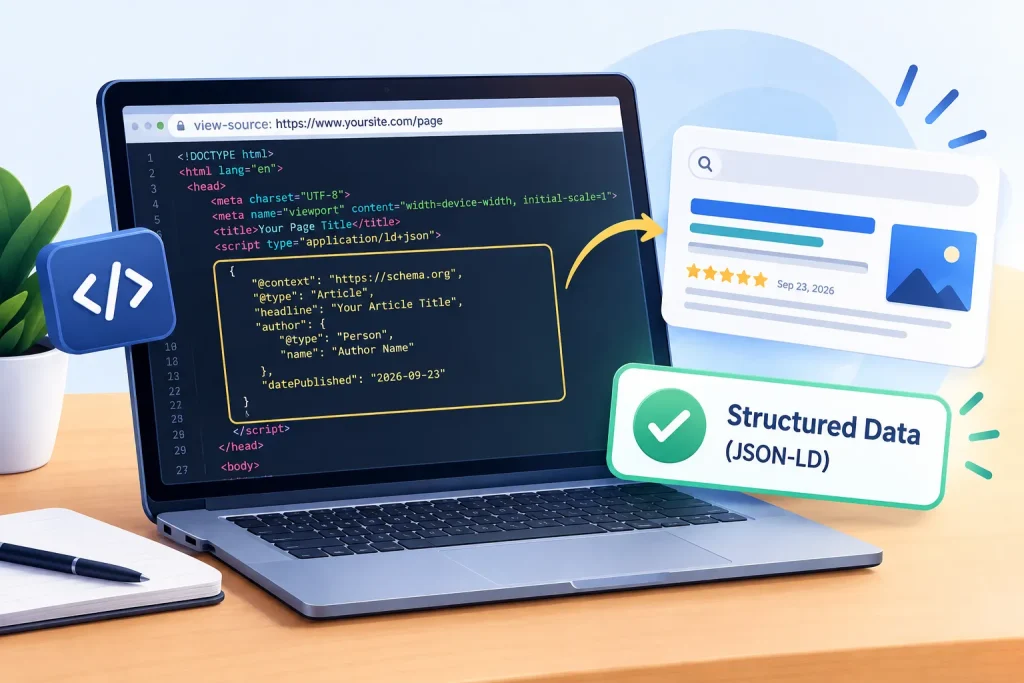
Structured data has to match your visible content and validate correctly to be considered for search features. Don’t mark up a five-star rating that isn’t shown on the page. Don’t add FAQ schema for questions your article doesn’t actually answer.
The schema types that carry the most weight for AI citation right now:
1Article or BlogPosting. Headline, author, publish date, modified date.
2. FAQPage. Only on pages with genuine Q&A content, not bolted on for the markup.
3. Organization. Name, logo, sameAs links to your real social profiles.
4. BreadcrumbList. Reinforces your site hierarchy for both bots and users.
Write the answer before you write the article
AI Overviews and AI Mode extract, they don’t read cover to cover. A page that opens with 200 words of throat-clearing before the actual answer is a page that’s hard to quote.
Put a direct, 2 to 3 sentence answer near the top. State the fact. Then expand underneath it with the context, the nuance, the “here’s why.” This is the single biggest structural difference between content that gets cited and content that doesn’t.
This also means understanding how AI systems choose and cite sources, which you can learn more about through AI citations.
E-E-A-T isn't a checkbox, and AI systems can tell
Experience, expertise, authoritativeness, trustworthiness. Google’s own quality raters have used this since 2022, and it’s now the same lens AI systems lean on when deciding what to cite.
What actually signals it, concretely:
1. A named author with a real bio, not “admin” or “team.”
2. First-hand specifics. “I tested this for 3 weeks” beats “many users report.”
3. Sources a reader can click and verify, not vague appeals to “experts say.”
4. Dates. Published and updated. AI systems weigh freshness heavily on anything that changes over time.
None of this is a plugin install. It’s an editorial standard, and it’s the one thing competitors can’t easily copy from you.
Go beyond text if you want multimodal visibility

Multimodal search, where someone searches with a photo and gets a synthesized answer, rewards pages that pair strong text with real images and video, and keeps Merchant Center or Business Profile data current. AI search is also becoming more interactive through voice-based experiences, with advances in AI-powered voice search.
If your content is text-only right now, that’s a gap, not a dealbreaker. Add one genuinely useful image or diagram per major section instead of stock photography as decoration.
A 5-step sequence, in order
1. Confirm AI crawlers aren’t blocked in robots.txt.
2. View-source your pages and check structured data actually rendered in static HTML.
3. Rewrite your opening so the direct answer lands in the first 2 to 3 sentences.
4. Add a real byline, sourcing, and dates to anything currently anonymous.
5. Pair your strongest pages with one useful image or video each.
Do these in order. Step 1 gates everything after it.
Conclusion
Ranking in AI search in 2026 is not about finding a secret AI SEO trick. Start with the basics: make sure AI crawlers can access your pages, keep important structured data visible in the HTML, and give readers a clear answer they can understand and trust.
Then strengthen the page with a real author, reliable sources, current information, and useful visuals where they add value. You don’t need to add every new AI-search file or plugin just because it is trending. Focus on the technical and content improvements that help both search engines and real readers find, understand, and use your content.
Explore practical strategies for AI search visibility, generative engine optimization, technical SEO, and content improvements, with more useful digital insights from One Final Draft.
Frequently asked questions
Do I need an llms.txt file to rank in AI Overviews?
No. Google does not currently use llms.txt for AI Overviews. Your robots.txt file and its user-agent rules are more important for controlling access to your website.
Why isn't my structured data showing up in AI search results?
Your schema may be added through JavaScript that some crawlers cannot see. Check your raw page source and make sure important structured data appears in the HTML.
Is E-E-A-T a direct Google ranking factor?
No. E-E-A-T is not a single ranking score. It is a quality framework that helps Google assess experience, expertise, authoritativeness, and trustworthiness.
What's the single fastest fix for AI search visibility?
First, check that important AI crawlers are not blocked by robots.txt. If crawlers cannot access your content, other SEO improvements may not help your AI search visibility.
Comments are coming soon. In the meantime, share this piece with someone who should read it.