
With the onset of the generative AI revolution in 2023, search has changed tremendously in these 3 years as compared to the previous decade.
Now users don’t have to go through every link to find answers; they get it right away with the help of AI. This efficient user-centric search approach favours search engines but has worried brands who still fight for mentions in AI answers despite doing everything right.
AI and SEO seem to be on opposite sides, as the phrase “SEO is dead” seems to appear in a new article every week.
This blog attempts to shed some light on the truth behind the noise. We have discussed:
What’s really driving the traffic decline many websites are seeing?
Is AI the biggest threat to SEO, or simply a shift in strategy?
What the future of SEO actually looks like once you get past the headlines.
Let’s start with the truth, first.
The Truth About What's Happening to Search Traffic
On Google or any other search engine, upon a search query, AI-generated answers now appear on a large share of searches, particularly for informational questions.
For example, for this very topic, take a look at the Google search results:
These direct answers appear at the top of the page, so naturally fewer people scroll down to click through to the website links, because their question has already been answered right at the top. When users feel they got what they came for on Google, they are more likely to use Google AI overviews.
But this has caused an actual traffic decline for many publishers, especially those who rely on simple how-to and definition-style content.
A 2026 study shows that organic click-through rates are dropping dramatically on queries that show these instant summaries, with an increase in what is known as zero-click search behaviour.
A zero-click search experience is when a person searches on a search engine and reads an answer that is referenced from a website but never visits a website at all.
So yes, there is real data supporting the concern behind AI and SEO.
But the picture isn’t as simple as total SEO collapse. Let’s move ahead to the ultimate question.
Will SEO Get Replaced by AI?
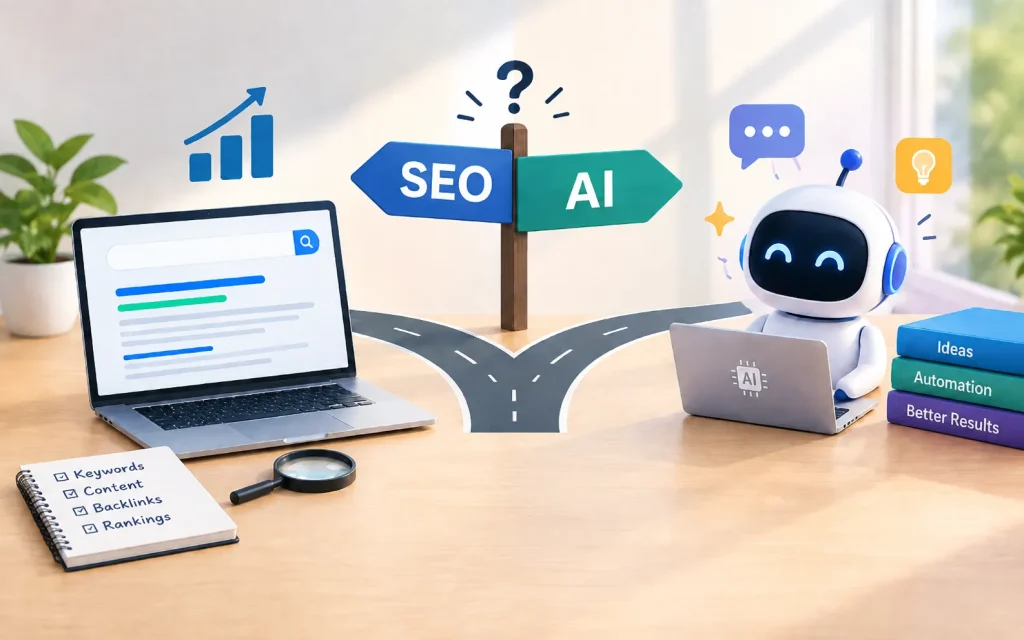
This is a hot question nowadays, and everyone really wants a truthful answer: will SEO get replaced by AI entirely?
It is probably keeping most marketers up at night, so let’s answer it honestly: based on the evidence so far, the answer is NO. SEO isn’t about to be replaced by AI.
The fact about AI and SEO is that SEO is not getting extinct but is being reshaped by AI, and pretending otherwise would be a bit dishonest.
What’s actually happening is that Google (and other search engines) now create their own AI-generated answers right on the results page, so people often get what they need without clicking through to a website at all. That’s where the fear comes from. But if you look closely at the data, the story isn’t “websites lose, AI wins.” It’s more like a reshuffling of who gets the traffic.
But don’t make the mistake of thinking that some of the traffic decline being reported isn’t very real.
Simple questions, definitions and basic how-to content are getting hit the hardest because AI can summarise those in a couple of sentences and the person never has to leave the search page. That’s part of the reason you’re seeing more zero-click searches.
But here’s the good news: Trusted, really useful websites that have been around for a while are still growing.
But when they want real depth, a second opinion, a comparison or are ready to actually buy something, people still click through. AI SEO hasn’t eliminated that. If anything, it has made trust and expertise more valuable, not less.
The future of SEO isn’t about competing with AI-generated answers. It’s about learning to show up inside the generated summaries.
SEO Is Evolving, Not Dying
SEO isn’t dying. It’s just growing up and learning a new set of rules. Here is how:
1. The goal has changed: Being in the ten blue links is no longer enough; brands need to be visible in the answers search engines are serving up on the page.
2. A new discipline has emerged: GEO (Generative Engine Optimisation) is the practice of earning a citation inside an AI answer, not just a spot in the results.
3. The basics still matter: Good AI SEO still depends on topical authority, solid technical foundations and real expertise, no matter what changes happen around them.
4. Trust is even more important: Brands that are mentioned in AI summaries get far more clicks than brands that rank well but aren’t mentioned.
This is what the future of SEO looks like in practice: not competing with AI, but learning to work alongside it: one strategy for the page and one strategy for the answer.
The New SEO Playbook: Winning Traffic When Google Keeps the Click
If Google is increasingly keeping a huge share of queries itself, right there on the results page, then the strategy has to change. This is where the new SEO playbook comes in.
The technical basics still matter, and it’s worth learning how to rank in AI search so your content can be found and cited in AI answers. But modern strategies shouldn’t be about competing harder for the same spot. They should be about building visibility and demand in places Google can’t quietly absorb.
Here’s what that looks like in practice:
1. Track citation share, not just rankings. Start checking, manually or with an AEO/GEO tracking tool, whether your brand actually gets mentioned inside AI-generated answers for your key topics. This is really what GEO is measuring, and it now matters just as much as where you sit in the traditional results.
2. Protect the query types least affected. Transactional, local, and brand-specific searches still convert to clicks far more reliably than broad informational ones, which are hit hardest by traffic decline. Shift some content budget toward these steadier, higher-intent query types.
3. Generate demand outside of search entirely. Email newsletters, YouTube, LinkedIn and niche online communities forge a direct relationship with your audience that no search update can quietly take away.
4. Go for depth, not answers. Zero-click search is mostly for quick, factual answers. Original research, honest opinion, and truly useful comparisons still get the click, because AI summaries can’t easily replicate real judgement or hands-on experience.
5. Strengthen branded search. When people search for your brand by name rather than a generic question, there’s usually no AI-generated answer standing in the way of the click. Consistent brand-building outside Google pays off inside it too.
6. Repurpose content in different formats. A single well-researched article can be a short video, a LinkedIn post and a newsletter feature, taking your reach well beyond a single search results page.
This is the practical answer to whether AI poses any threat to SEO:
Redirection instead of retreat and building an SEO strategy sturdy enough that doesn’t collapse every time Google changes how it displays an answer.
So, Is AI the Biggest Threat to SEO?
Putting AI and SEO on opposing ends misses the point entirely. AI SEO is not a competing discipline. It is an important building block of the digital future.
Combine solid technical SEO, strong generative engine optimisation practices, and a content strategy built on real expertise, and you’re not competing with AI. You’re simply working with search the way it now actually works.
Yes, zero-click search will continue to grow for simple questions, and yes, some falling traffic is unavoidable for thin content. But the future of SEO isn’t bleak for those willing to adapt. SEO is not dying, it’s evolving, and the early adopters will still be winning traffic long after this current wave of panic has passed.
Conclusion
AI is changing how people search, but it is not making SEO irrelevant. Search is moving beyond traditional rankings toward AI answers, citations, brand visibility, and stronger user-focused content. Websites that build expertise, improve technical SEO, create original content, and adapt to generative search can continue to earn visibility. The key is not to fight AI, but to understand how search is changing and adjust your SEO strategy accordingly.
Explore the latest insights on AI SEO, generative engine optimisation, search visibility, zero-click searches, and the evolving search landscape with more useful digital marketing insights from One Final Draft.
Frequently asked questions
Is AI going to replace SEO?
AI is changing how search results are displayed, but SEO still matters. Websites need strong content, technical foundations, authority, and visibility across traditional and AI-powered search.
What is AI SEO?
AI SEO refers to optimising content and websites for visibility in AI-powered search experiences. It focuses on useful content, expertise, clear information, and increasing the chances of being referenced in AI-generated answers.
Why are websites losing organic traffic?
Websites may lose traffic because AI-generated answers and zero-click searches provide information directly on search results pages. Informational and simple how-to queries can be especially affected.
How can businesses adapt to AI search?
Businesses can focus on original research, useful content, technical SEO, brand visibility, and generative engine optimisation. Building demand through email, video, social platforms, and communities can also reduce reliance on search clicks.
Comments are coming soon. In the meantime, share this piece with someone who should read it.