
Remember being stuck on a homework question at night?
The teacher’s gone home. Your friends are asleep. The textbook explains it the same confusing way, no matter how many times you read it. So you give up, copy a classmate’s answer in the morning, and move on without understanding a thing.
That used to be normal. In 2026, it’s changing.
Today a student can open an AI tutor and type, “Explain this like I’m 12.” Then, “Give me an example from real life.” Two minutes later, it makes sense. No waiting, no feeling silly for asking.
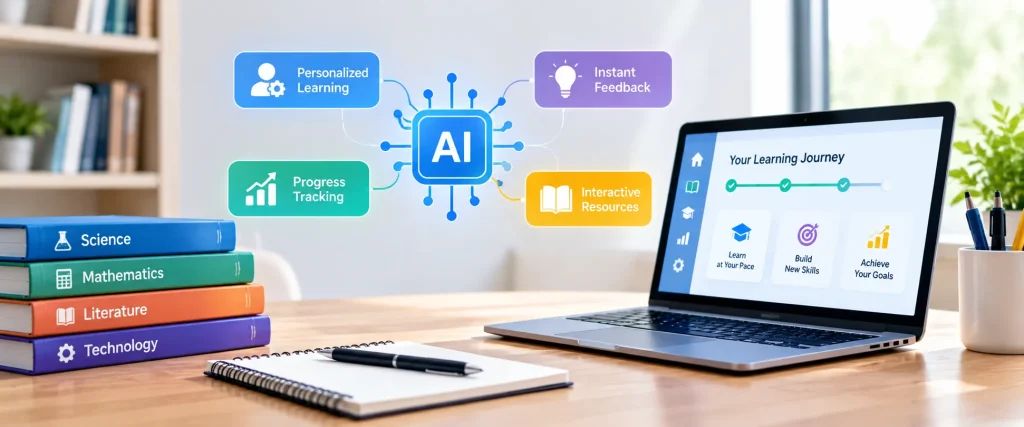
AI is changing how students learn in a big way. AI in education uses computer programs to answer questions, provide feedback, and help students practice important skills. Research suggests these tools can support personalized learning while giving teachers new ways to meet individual student needs. However, they also raise concerns about privacy, bias, data security, and the need for proper teacher training. Understanding these challenges is essential for using this technology responsibly in education.
Why AI-powered learning is growing so fast?
Think about a normal classroom. 1 teacher, 30 students, 45 minutes. Some kids get it right away. Some need a slower explanation. Some are bored.
One teacher can’t teach 30 different ways at once. AI can get close.
AI tutors notice where you struggle and how you ask questions. Then they change the explanation to fit you. Learning platforms do the same with speed: they move faster when you’re doing well and slow down when you’re stuck.
Technology in education used to mean putting textbooks on a screen. Now the screen answers back.
AI tools for students: how people really use them
The first wave of homework helpers just handed over answers. Most of the big names have since built something that makes you sweat a little.
1. NotebookLM: upload your notes and readings, ask questions, or turn them into an audio recap. It sticks to your material, so it makes up less.
2. Khanmigo: Khan Academy’s tutor. Ask for the answer to an algebra problem and it asks what you tried first. Annoying. Effective.
3. Duolingo Max: roleplay chats in the language you’re learning, which beats 50 flashcards.
4. Study modes in ChatGPT, Gemini, and Claude: flip one on and the assistant starts quizzing you instead of lecturing.
For students who prefer speaking over typing, ChatGPT’s real-time voice conversations can make AI-assisted learning feel more interactive and conversational.
Look at that list again. Every good use puts you to work. The bad ones (summarize this, write that, fix my essay) feel productive and leave you exactly as ready for the exam as you were before.
Does it really work? What the research says
Plenty of tech promises big results. So here’s a real example.
Physics-STAR is an AI tutor built for high school physics. In a controlled study, students who used it did better than students in regular teacher-led lessons. They solved problems faster and understood hard ideas more deeply.
The best part: the tutor made students think about “why” and “how,” and not only the final answer.
Another study examined AI tutors working alongside teachers. The combination provided students with support at a lower cost and both engagement and results got better.
A single study, in one subject can’t prove everything. Still the message is clear: AI helps the most when a real teacher is involved.
Who gets the biggest benefit?
I think it’s working adults and first-generation college students.
Imagine working full time, looking after family, and going back to school after years away. Or being the first person in your family to go to college, with nobody at home who’s done it before. FNU explains that AI can add extra guidance on top of the support schools already offer: flexible help on a busy schedule, quick feedback, and clearer steps for assignments.
When your only free hour is 1 a.m., a tutor who’s awake at that time means a lot.
Will AI take over teachers' jobs?
I don’t think so. Teachers who learn to use AI will probably do better than those who ignore it.
AI is great at patience, fast feedback, and explaining the same idea 6 different ways. Teachers bring things a computer can’t: care, encouragement, good judgment, and the ability to see that a student is having a rough week.
The World Economic Forum says AI could take over up to 20% of teachers’ admin work, like checking drafts and marking. That gives teachers more time to sit with students one on one, which is where they help most.
The problems people worry about
AI in education has real downsides. UNESCO has talked about most of these:
1. Unequal access. Some students don’t have a good device or steady internet. If only well-off students get AI tools, the gap grows.
2. Privacy. Student information is personal. Schools need clear rules and strong protection.
3. Leaning on AI too much. If you believe every answer without checking, your own thinking gets weaker. I see this as the biggest everyday risk.
4. Untrained teachers. Many teachers haven’t had proper AI training yet.
FNU also mentions unfair results from biased tools, which is why students need to learn how to question what AI tells them.
How to use AI and still learn?
Here’s what works for me, and I’d give the same tips to any student:
1. Try the problem first. Give it 10 minutes before asking for help.
2. Ask for hints. “What’s my next step?” teaches you more than “Solve this.”
3. Show it your mistakes. Paste in your wrong answer and ask where your thinking went off track.
4. Double-check. AI can be wrong while sounding totally sure. Compare with your textbook.
5. Know your school’s rules. Policies differ, and breaking them can get you in trouble.
Conclusion
AI in education isn’t some far-off idea. It’s already in classrooms, hostels, and late-night study sessions.
The students who gain the most use AI like a study partner. They try first, ask good questions, and check the answers. The schools that gain the most keep teachers at the center and take privacy and fair access seriously.
Technology will keep changing. One thing stays the same: the point is for every student to understand something today that they didn’t understand yesterday.
Discover useful education insights, learning strategies, and fresh ideas at One Final Draft, and share your expertise with readers through our Write for Us opportunities.
Frequently asked questions
How is AI changing the way students learn in 2026?
AI is helping students personalize learning, understand difficult topics, get instant explanations, practice skills, and organize their study routines.
What are the benefits of AI in education for students?
AI can provide personalized learning support, quick feedback, adaptive practice, research assistance, and learning resources based on individual needs.
Can AI replace teachers in the classroom?
AI can support teachers with learning activities, feedback, and personalized resources, but teachers remain important for guidance, communication, creativity, and human connection.
How can students use AI responsibly for learning?
Students can use AI to understand concepts, brainstorm ideas, practice questions, and receive explanations while checking information and completing their own thinking and work.
Comments are coming soon. In the meantime, share this piece with someone who should read it.