
A bakery owner in Ohio used ChatGPT to write her Instagram captions last month. She also decided which supplier to switch to after her flour costs jumped 12%. Only one of those tasks got automated.
That’s the real split happening in small business right now. AI is taking over tasks. It isn’t taking over owners.
What the 2026 data actually shows
Adoption numbers vary by survey, but the direction is the same everywhere. Intuit’s 2026 AI Impact Report, built from over 34,000 business owners and anonymized data from 5.3 million businesses, found more than 3 in 4 small and midsize businesses now use AI regularly. That’s up from 48% in July 2024.
The U.S. Chamber of Commerce puts 2026 adoption at 66%, up 8 points from 2025 and nearly 3 times the 23% that used AI in 2023. Homebase’s Main Street report found something similar: 74% of small business owners and managers are now using or piloting AI tools, up from 64% a year earlier.
Here’s the part that matters for the “replace” question. The Homebase report found small business decision-makers are more than twice as likely to expect AI to help their business grow (49%) than to reduce headcount (22%). The Chamber’s numbers back this up too: 95% of AI-using small businesses say they’re working to upskill employees, and 47% say AI is creating jobs, not cutting them.
What AI actually replaces in a small business
Be specific about what’s getting automated, because the vague version of this question (will AI “take over”) doesn’t match how owners are using the tools.
Writing and admin work. Emails, social captions, product descriptions, meeting notes. Business.com research found the average small business worker saves 5.6 hours a week using AI, and owners save over 7.
Customer support, partly. By the end of 2026, 80% of small businesses plan to have AI chatbots handling some customer support. AI voice conversations can also make customer interactions more natural and responsive. That’s first-line questions, not the angry phone call that needs a human who can actually fix something.
Bookkeeping and data entry. Categorizing transactions, flagging anomalies, drafting invoices. This is the least glamorous win and probably the biggest one, since it used to eat hours every week.
Research and first drafts. Market research, competitor scans, a first pass at a business plan. AI gets you to 70% faster. You still do the last 30%.
What AI still can’t do
Make the call when the data runs out. AI can model 3 pricing scenarios. It can’t tell you which one your regular customers will tolerate without a chargeback spike, because it doesn’t know your customers.
Build trust with a supplier or a landlord. Business relationships run on history and reputation. A chatbot has neither.
Take the legal and financial risk. When a decision goes wrong, somebody’s name is on the loan, the lease, the payroll. That’s not a function a model can perform, however good the output looks.
Read a room. Knowing when to push a client and when to let something go is judgment built from doing it wrong a few times. (Nobody writes that into a training set.)
Hire for fit, not just skills. AI can screen resumes. It can’t tell you whether someone will actually work well with your existing 4-person team.
Why the “replace the owner” framing misses the point
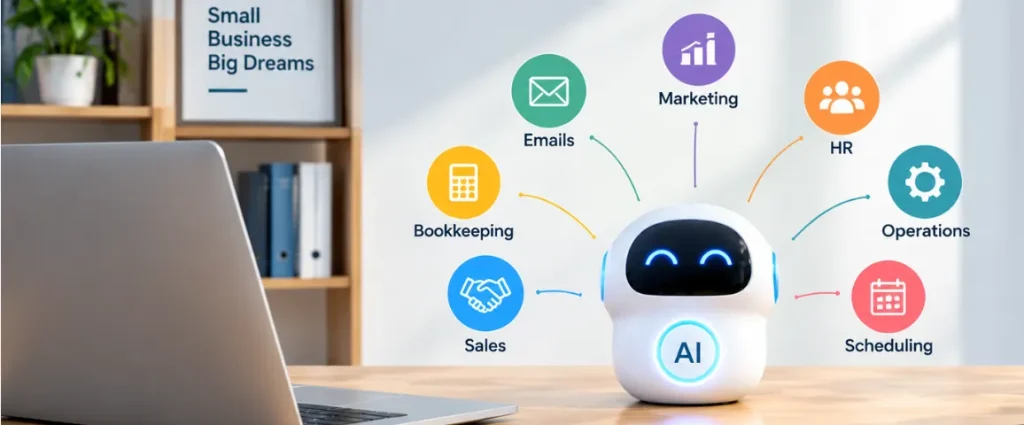
Most owners don’t run one job. They run 6: salesperson, bookkeeper, marketer, HR, operations, and the person who unlocks the door at 7am. AI is good at single, well-defined tasks. An owner’s job is mostly connecting dozens of those tasks into decisions, which is a different skill than any one task on the list.
The Bluevine 2026 Small Business AI Trends Report found something else worth noting. Claude usage among small business customers grew 729% year over year, and by April 2026 it had overtaken ChatGPT in monthly transactions among Bluevine’s customers. Owners aren’t using one AI tool for everything. They’re picking different tools for different jobs, the same way they’d pick a bookkeeper for taxes and a different person for marketing.
Where this actually goes wrong for owners
The risk isn’t replacement. It’s owners who stop at “using AI” without going further. A 2026 report from Lonely Entrepreneur found 58% of small businesses now use generative AI, up from 40% a year earlier, and 91% of users say it boosts revenue. But only 27% feel confident doing it, and 51% describe themselves as “explorers” who test tools without committing. Just 8% reach advanced use.
That gap costs real money. McKinsey put the average ROI on small business AI investment at 3.7x in 2026. Owners stuck in explorer mode are leaving most of that on the table.
What to actually do with this
Pick one task that eats the most hours in your week. Automate that one thing first, then measure what it actually saved before you add a second tool.
Don’t hand over anything that involves judgment about a specific customer, a specific employee, or a specific legal risk. Keep the AI on drafts, research, and repetitive admin. Keep yourself on the decisions that carry consequences.
That bakery owner still decides which supplier gets her business. AI just writes the caption announcing the new flour.
Explore how AI can support small business owners, automate repetitive tasks, and improve efficiency while human judgment remains essential with more useful business insights from One Final Draft
Frequently asked questions
Will AI replace small business owners?
AI is unlikely to replace small business owners because it automates specific tasks, while owners still make decisions, manage relationships, take risks, and lead their businesses.
What tasks can AI automate for small businesses?
AI can automate repetitive tasks such as writing emails and social captions, customer support, bookkeeping, data entry, research, meeting notes, and product descriptions.
What can AI not do for small business owners?
AI cannot fully replace human judgment, trust-building, relationship management, legal responsibility, or the ability to understand customers and employees in real-world situations.
How should small business owners use AI effectively?
Small business owners should start with one repetitive, time-consuming task, measure the results, and gradually expand AI use while keeping important decisions under human control.
Comments are coming soon. In the meantime, share this piece with someone who should read it.