

Consumer psychology explains something that every business wants to understand: why do people purchase one product and ignore another?
On the surface level, buying looks simple. A customer needs something, compares a few options and opts for the best one. But when it comes to reality, people do not always make buying decisions in such a straightforward manner.
A person may choose a familiar brand even when the other option is cheaper. They might buy because a product looks better, feels safer, has strong reviews, and reminds them of a positive experience. Sometimes, they may not even know the exact reason behind their choice.
This is where consumer psychology becomes important. It enables the brands to understand the thoughts, emotions, habits, and social influences that shape consumer behaviour. Moreover, it also shows why buying decisions are rarely based on logic alone.
For marketers, business owners, and content teams, understanding purchase psychology is not about manipulating consumers; it is more about learning what people need, what they fear, what they trust, and what helps them feel confident before they buy.
What is Meant by Consumer Psychology?
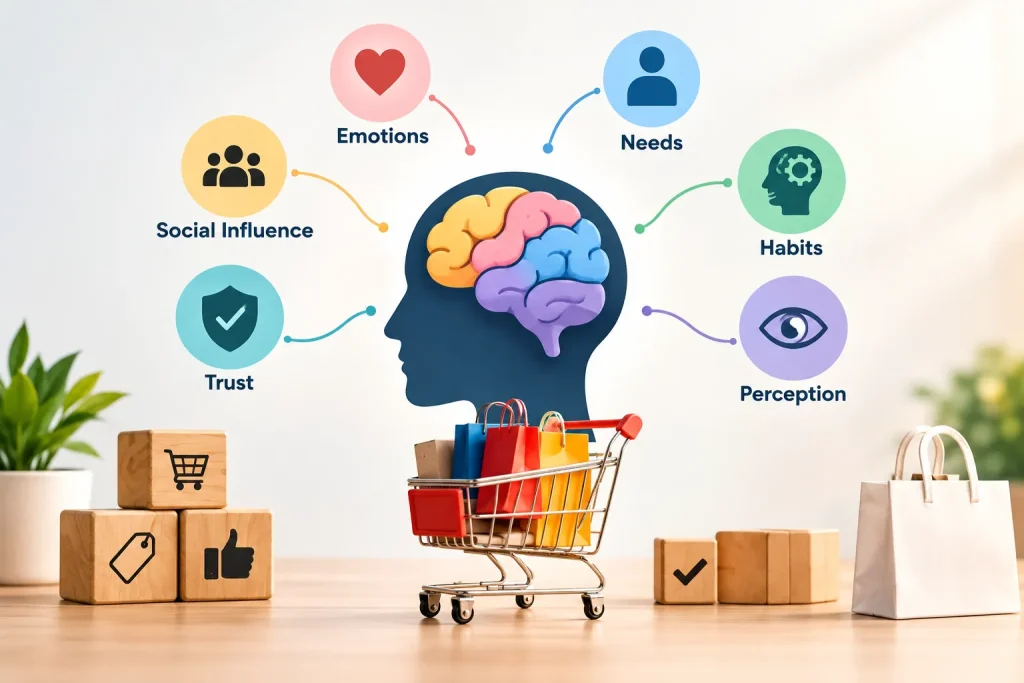
Consumer psychology is the study of how people think, feel, and behave when they choose, buy, use, and reject products and services.
It looks at questions like the following:
1. What makes a customer notice a brand?
2. Why does one offer feel more attractive than the other?
3. How do emotions affect buying decisions?
4. Why do reviews, recommendations, and social proof matter?
5. What makes a consumer return to the same brand again?
As per Wikipedia’s overview of consumer behaviour, consumer behaviour studies the activities that are linked with the purchase, use and disposal of goods and services. It also explores how emotions, attitudes, and preferences affect buying behaviour.
In simple words, consumer psychology helps to explain the invisible thinking behind the visible actions.
A consumer clicking on the product, adding it to the cart, comparing prices, and leaving without buying is not random. Each action is influenced by needs, memories, habits, confidence, doubt, and timing.
Why Does Consumer Psychology Matter for Brands?
There are many businesses that rely heavily on product features. They explain what the product does, how much it costs, and why it is better than the competitors.
Well, this information matters, but it is not always sufficient.
Customers should therefore ask emotional and practical questions in their minds:
1. Can I trust this brand?
2. Is it worth the money?
3. Will this solve my problem?
4. What if I make the wrong choice?
5. Are other people happy with it?
6. Does this brand understand my needs?
This is why consumer psychology plays an important role in marketing. It helps the brands to address real concerns rather than only listing features.
For instance, a skincare brand may claim that its products contain niacinamide. This is a feature. But on the contrary, a customer may worry more about the fact of whether the product helps with fighting dullness, suits their sensitive skin, or helps them feel more confident.
Efficient marketing helps in connecting the product features with the customer’s real motivation.
How Do People Really Make Buying Decisions?
Most people like to believe that they make only logical decisions. But in reality, the buying decisions are shaped by both logic and emotion.
The general process of consumer decision-making consists of the 5 stages mentioned below:
1. Recognising a need
2. Searching for the information
3. Comparing options
4. Making a purchase
5. Evaluating the decision after buying
This process may look simple on paper, but customers often move through it unevenly. Some decisions happen in minutes, while some take weeks.
An individual buying a cookie may decide quickly. But a person choosing a laptop, a course, a property, an insurance plan, or a business service may compare more options before taking the final decision.
This is the reason that the brands should understand the emotional weight behind different purchases. A low-cost impulse buy requires a quick appeal. A high-value purchase requires trust, clarity, and reassurance.
How Consumer Psychology Works During Buying Decisions
Buying decisions do not happen in one simple step. Customers move through different stages, and each stage is shaped by different thoughts, emotions and doubts.
| Decision Stage | What the Customer Thinks | What Influences the Decision |
|---|---|---|
| Need Recognition | Do I need this product or service? | Problem, desire, lifestyle need or emotional trigger |
| Information Search | Which options are available? | Website content, ads, search results, reviews and recommendations |
| Comparison | Which option feels better? | Price, features, trust, quality, offers and brand familiarity |
| Doubt Reduction | Can I trust this brand? | Reviews, return policy, secure payment, proof and clear communication |
| Purchase | Should I buy it now? | Urgency, convenience, price, availability and confidence |
| Post-Purchase Evaluation | Was this decision worth it? | Delivery, product experience, support, satisfaction and value |
The Role of Emotion in Purchase Psychology
Emotion is one of the strongest forces in purchase psychology.
Customers may use logic to justify their purchase, but it’s the emotions that create the first pull. Well, a product may make them feel safe, smart, successful, attractive, prepared, and included.
Forbes also discusses the psychology behind shopping behaviour by explaining how retail experiences, emotions, and subconscious cues can influence buying decisions beyond basic product need.
This does not mean that the customers are irrational. It simply means that emotions enable them to assign meaning to a product.
For instance:
1. A luxury watch may represent achievement.
2. A family car may represent safety.
3. A fitness programme may represent self-control.
4. A premium phone may represent a status of convenience.
When brands understand emotional motivation, their messaging becomes sharper and clearer. They stop saying “buy this product” and start explaining, “this is how life becomes easier, safer, and better.”
Trust Reduces Buying Doubt
Trust is one of the most important parts of consumer psychology.
When customers don’t trust a brand, even a strong offer can fail. They may worry about quality, delivery, refunds, hidden charges, and after-sales support.
Trust is one factor that becomes even more important for online purchases, financial products, healthcare services, educational programmes, and high-value items.
Brands can build trust through the following:
1.Clear product information
2. Honest pricing
3. Customer reviews
4. Easy return policies
5. Secure payment options
6. Real images and proof
7. Expert content
8. Consistent communication
Moreover, trust also reduces decision fatigue. When customers feel confident about a brand, they will spend less time doubting every detail.
This is also the reason that the repeat customers buy faster than the first-time customers. Their previous experience has already reduced that uncertainty.
Social Proof Helps in Shaping Customer Behaviour
People often look at others before making buying decisions.
This is also known as ‘social proof’, which means that the customers feel more confident when they see that others have already chosen, used, or recommended a product.
Social proof can include the following:
1. Reviews
2. Ratings
3. Testimonials
4. Case studies
5. User-generated content
6. Influencer recommendations
7. Word-of-mouth referrals
8. “Best-selling” labels
Social proof works because customers don’t feel alone in their decision. If many people trust a product, the risks feel lower. At the same time, social proof should be genuine. Fake and exaggerated claims can easily damage the brand’s credibility.
Today, the customers are more alert. They can easily sense when the customer reviews sound too polished or unrealistic.
Simple, specific, and honest customer feedback generally works better than dramatic praise.
Why Does Pricing Feel Psychological?
Well, pricing is not just a number. It is a signal.
Customers often make use of pricing to judge quality, value, and risk. A very low price may attract attention, but it can also create doubt. A high price may suggest better quality, but only if the brand provides sufficient proof.
This is why pricing plays an important role in purchase psychology.
Common pricing effects include the following:
1. Discounts create urgency
2. Premium pricing builds perceived value
3. Bundles make offers feel more complete
4. Free trials help in reducing risks
5. Instalments make large purchases feel easier
6. Pricing comparison helps the customers judge value
For example, a product priced at INR 100 may look more attractive than a product retailing for INR 110, even though the difference is small. This is due to the fact that customers respond to how prices are presented and not only to the actual amount.
The Power of Familiarity

Customers often prefer what feels familiar.
This is why consistent branding is important. Colours, logos, packaging, website layout, and repeated messaging all help the customers recognise a brand.
Familiarity, in turn, creates comfort. When people see a brand again and again, it begins to feel safer and easier to choose.
This also does not mean that every familiar brand will win. But familiarity plays a key role in reducing resistance during the consumer decision-making process.
On the other hand, for new brands, this simply means that consistency is important. A brand that frequently changes its message, design, and tone too often can confuse customers. A clear and well-defined identity helps people to remember the brand when they are ready to buy.
Why Do Too Many Choices Confuse Customers?
Many businesses believe that more choices always improve sales. But this is not always true.
Too many options can also make the customers feel overwhelmed. When people cannot easily compare products, they can either delay the purchase or leave without deciding.
This is also known as choice overload.
Well, a customer looking at three clear packages may decide quickly, whereas a customer looking at fifteen similar packages may feel stuck.
Brands can easily reduce confusion by:
1. Clearly grouping the products
2. Highlighting best-fit options
3. Using comparison tables
4. Giving simple recommendations
5. Explaining who each product is for
6. Keeping the website navigation clean
Post-Purchase Feelings Are Important Too
The buying journey does not end after payment.
Customers continue to judge the brand even after the purchase. They notice the delivery speed, packaging, product quality, support, and whether the product matches the expectations or not.
This stage is important as it affects repeat purchases, reviews, and referrals.
If the customers feel satisfied, they might return. But if they feel disappointed, they may complain or simply switch to another brand.
Poor purchase experiences can be improved through the following:
1. Clear order updates
2. Easy onboarding
3. Helpful support
4. Honest delivery timelines
5. Simple return policies
6. Follow-up guidance
Strong consumer psychology does not stop at conversion. It looks at the complete customer experience.
How Can Brands Use Customer Psychology Ethically?
Understanding consumer psychology offers brands influence, and that influence should be used with utmost responsibility.
In fact, ethical marketing enables customers to make better decisions. It does not pressure them with false urgency, hidden terms, or misleading claims.
Brands can use psychology ethically by:
1. Explaining the benefits clearly
2. Removing confusion
3. Showing honest proof
4. Making prices transparent
5. Respecting the concerns of the customers
6. Avoiding fear-based exaggeration
7. Helping the buyers choose the right product
When the customers feel respected, they are more likely to trust the brand for the long term.
Wrapping Up
Consumer psychology shows that people do not make buying decisions only through logic alone. Their choices are shaped by emotions, trust, social proof, price, familiarity, timing and past experiences.
This is why brands should look beyond features and offers. They need to understand what customers feel before, during, and after a purchase.
Therefore, good marketing does not force people to buy. But it helps them to understand the value, reduce doubt, and make them feel confident about their choice.
When brands understand consumer behaviour and apply ethical purchase psychology, they create clearer messages, better consumer experiences, and stronger long-term relationships.
Understand how consumer psychology shapes buying decisions and discover practical insights into emotions, trust, behaviour, and ethical marketing with One Final Draft.
Frequently asked questions
What is consumer psychology in simple terms?
Consumer psychology is the study of how people think, feel, and behave when they choose, buy, or reject products and services. It also helps the brands to understand why customers make certain buying decisions.
Why is consumer psychology important in marketing?
Consumer psychology enables marketers to understand customer needs, emotions, doubts, and motivation. This further enables the brand to create clearer messages, better offers, and more useful customer experiences.
What factors affect customer decision-making?
Customer decision-making can be affected by price, trust, reviews, emotions, brand familiarity, social proof, personal needs, and past experiences. In addition, the level of risk and cost also affects how carefully people decide.
How does consumer behaviour affect after-sales?
Consumer behaviour affects how people discover, compare, choose, and return to the brands. When businesses understand this behaviour well, they can easily improve product positioning, website experience, pricing, and customer communication.
Comments are coming soon. In the meantime, share this piece with someone who should read it.