

You sit down with your books, read the paragraph around 3 to 4 times, and still cannot remember what it said. On the other hand, a notification appears, you check your phone for “just one minute”, and suddenly you realise that almost 30 minutes have gone by.
Does this situation sound familiar?
Not being able to concentrate properly does not highlight the fact that you are lazy or unprepared. It simply means that your mind might be tired, overwhelmed, or simply distracted by the amount of work that is waiting for you.
The solution here is not to study for longer hours, but sometimes you should change how you study for exams.
We have listed down some of the efficient and practical methods that will help you remain focused, enable you to retain the information, and also help you make steady progress without forcing you through rigorous hours of unproductive study.
Start With a Five-Minute Study Goal
When you cannot focus, telling yourself to complete an entire chapter can make the task feel even heavier. However, a smaller starting point will feel easier to manage.
So, you should set time for 5 minutes and choose one clear task, like the following:
1. Reading 2 pages
2. Revising 5 definitions
3. Solving 1 question
4. Summarising one concept
5. Organising notes for one topic
Once you get started, you will find it easier to continue. Even if you stop or plan to pause after 5 minutes, you would have made a little progress.
Well, this approach also helps in improving student productivity as it replaces a vague goal, say “study chemistry,” with something more specific and action-oriented. After all, the aim is not to finish everything at once but to create a pace to start.
Break Large Topics Into Smaller Sessions
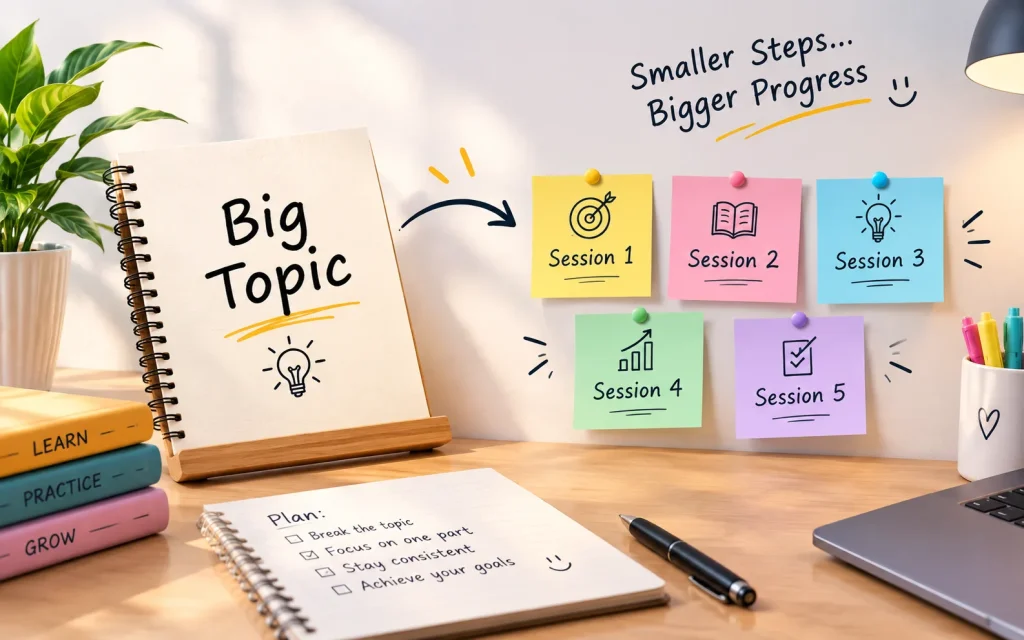
Trying to complete 1 entire chapter in a single sitting can quickly affect your attention span. Rather, you should divide the material into smaller topics and study each one separately.
For example, rather than planning to revise the biology subject, you should create smaller tasks like the following:
1. Revise cell structure
2. Revise all diagrams
3. Answer 5 practice questions
4. Test key terms
5. Rectify previous mistakes
You should do this for approximately 25 to 40 minutes and then take a break. You can easily adjust the length as per your attention span.
Perhaps one of the most useful exam concentration tips is that you should avoid measuring progress only through hours. A 30-minute session can be more useful than two distracted hours of self-studying.
Get Rid of Distractions Before They Impact You
Willpower cannot be relied upon, especially when your phone is beside you, messages are appearing, and several browser tabs are still open.
So, here your goal is to make it harder for distractions to access your mind before you start studying for your exams. Put your mobile phones on silent mode. Close all the unnecessary tabs, turn off the notifications, and keep only the books or the files within your reach.
Well, your study space does not have to look Pinterest-y, as it only needs to make your next action obvious.
Keep the following essentials within your reach:
1. Water
2. Required textbooks
3. A notebook
4. Pens
5. Highlighters
6. Study timetable
Removing all sorts of distractions will support student productivity by reducing the number of decisions that your brain must make.
Read With a Question in Mind
Passive reading often results in wandering attention. Your eyes might move across the page; however, your mind does not actively process the information.
So, to improve your focus on reading, turn the headings into questions before you get started with a section. For instance, change “Causes of the French Revolution” to “What Caused the French Revolution? ”
Now with that direction in mind, read to find the answer.
After you have finished a page, close the book and explain the main idea in your own words. You can say it out loud, write a summary, or pretend that you are teaching it to someone.
This will not only keep your mind involved but also help you notice which parts need further revision.
Test Yourself Instead of Repeatedly Rereading
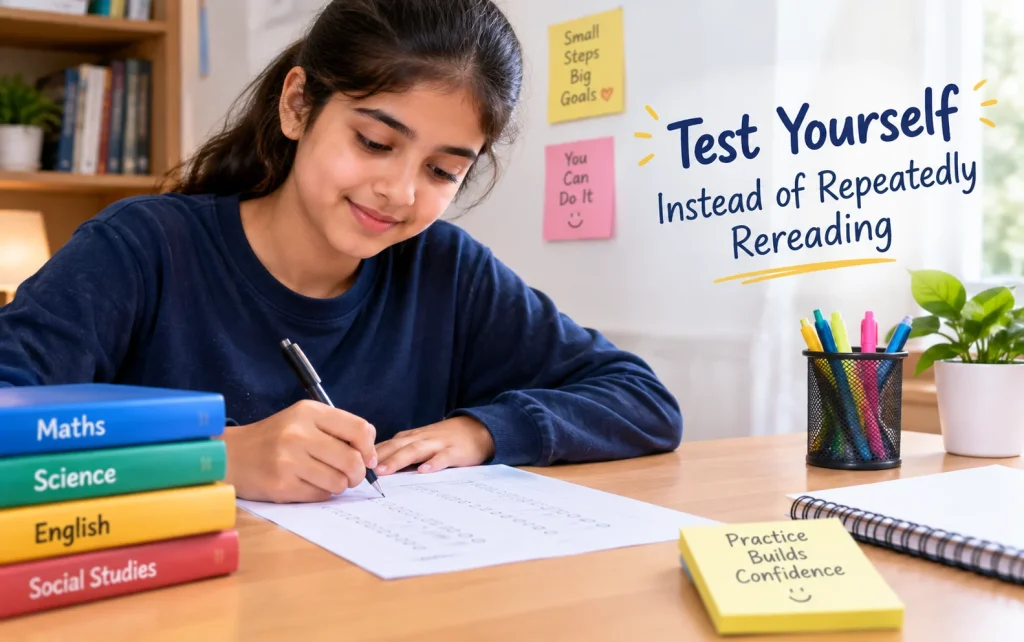
Rereading your notes is a healthy exercise, as it will create a feeling that you know the topic because the information in the books is familiar. But reorganising an answer is totally different from recalling it independently.
Once you have studied a topic, close your book and try to recollect as much as you can remember. You can also use:
1. Flashcards
2. Practice papers
3. Short quizzes
4. Blank-page summaries
5. Questions from previous exams
6. Diagrams that are drawn from memory
When an answer is wrong, review it and test yourself again later. Mistakes are not proof that the session failed. They simply reflect on the point from where you should start the revision again.
Use a Distraction Page
Whenever you sit down to study, you’ll realise that random thoughts start appearing as soon as you open your books. So, to break this chain of distractions, you can remember a message that you need to send. Something you need to buy, or another subject that you have not revised.
Rather than acting upon each thought, keep a “distraction page” beside you.
You can easily write down your thoughts and return to your work. For example:
1. Reply to a classmate
2. Check tomorrow’s timetable
3. Find notes for chapter 6
4. Charge calculator
5. Search for the past paper
This will reassure your mind that the thought will not be forgotten. It is a simple technique that will protect your attention and also help in improving student productivity without expecting your mind to be completely silent.
Match the Task to Your Energy Level
Not every hour of the day will provide you with the same level of mental energy. Some students may concentrate better in the morning, while others work more effectively in the evening.
You should notice when you feel most alert and keep that period aside for the most important and demanding tasks, such as solving numerical problems, learning new concepts, or writing essays.
You can use your low-energy periods for simpler activities, like
1. Organising and rearranging notes
2. Reviewing flashcards
3. Watching an assigned explanation
4. Correcting answers
5. Reading familiar material
Take Breaks That Refresh You
A study break should help you refresh your mind. But opening social media can turn a five-minute pause into a much longer distraction.
So, you should choose breaks with a clear ending. Stand up, stretch, drink water, walk around the room, and look outside for a few minutes.
You should strictly avoid starting an episode, a game, or a long conversation when you intend to quickly return to your books.
These short pauses are useful exam concentration tips; it becomes difficult to stay attentive during prolonged work. A planned break will allow you to return easily rather than waiting until exhaustion forces you to stop.
Protect Your Sleep Before an Exam
When revision is not complete, reducing sleep may look like the best alternative to gain those extra hours. But a tired mind will read slowly, lose its focus quickly, and struggle to recall the information.
So, you should set up a realistic stopping time, especially during the final days nearing your exam. Moreover, you should utilize the last part of your evening for light revision rather than starting a new topic.
Sleep should not be seen as time wasted during the course of preparation. Instead, treat it like the process that will help your brain retain whatever you learned.
Create a Simple Restart Routine
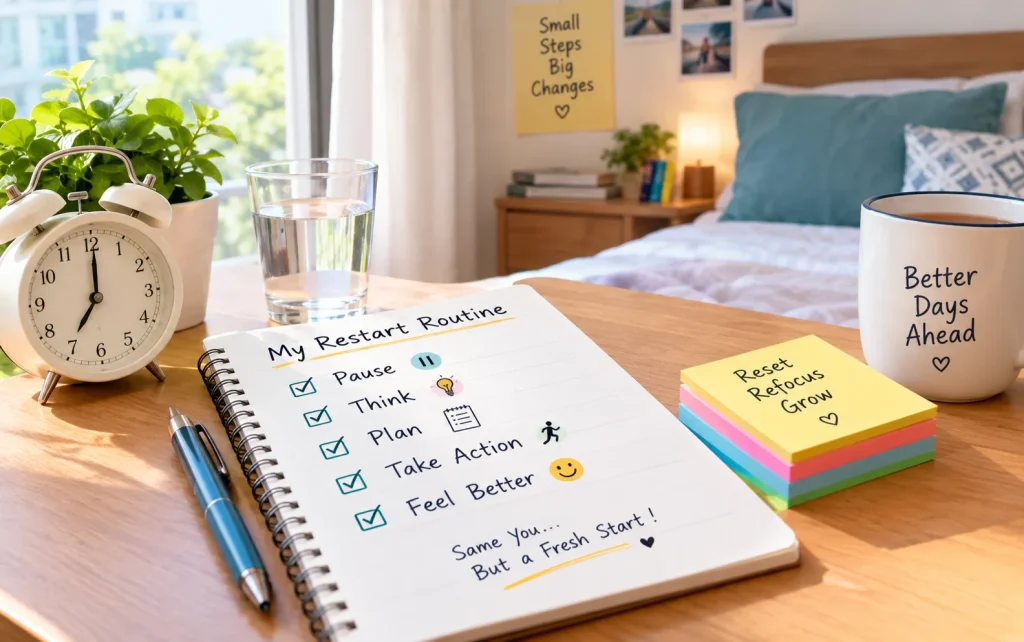
There will be days that will not go as per the plans. You may lose your focus, start late, or complete less than what was expected. Do not allow one poor session to ruin the rest of the day. So, you should start a simple restart routine:
1. Leave the desk or your study area for 2 minutes
2. Drink water and take a few slow breaths
3. Choose one small task
4. Set a short timer
Therefore, good student productivity is not about following a perfect timetable. It is about knowing how to restart after a distraction.
Wrapping Up
When you cannot concentrate, studying for longer is rarely the only answer. The better and most efficient approach here is to reduce the size of the task, remove distractions, and use active methods to keep your mind involved.
So, start with the five-minute rule. Ask questions while reading. Test yourself rather than reviewing the same pages over and over again. Take short breaks and protect your sleep.
Well, learning how to study for exams is not about being focused every second. But it is about creating a system that will help you to return to the task whenever your attention moves somewhere else.
Explore practical study hacks, exam preparation tips, and focus strategies on One Final Draft, with opportunities to share your own ideas through Write for Us.
Frequently asked questions
How can I study for exams when I cannot focus?
You should start with a five-minute task, remove distractions, and use a timer.
How can I improve my focus on reading?
You should turn the headings into questions and summarise each section in your own words.
How long should a study session be?
Try 25 to 40 minutes of focused study followed by a short break.
Do breaks impact student productivity?
No. Short and planned breaks can help in preventing fatigue and improving productivity.
Comments are coming soon. In the meantime, share this piece with someone who should read it.