
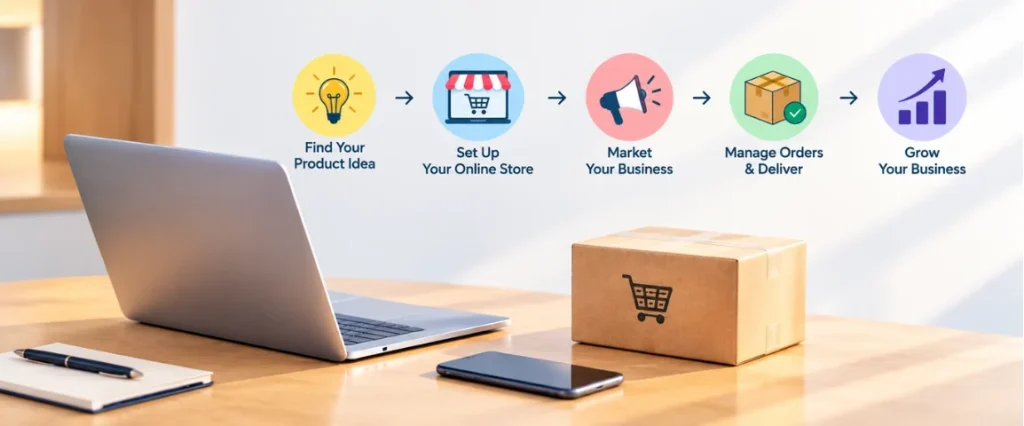
How to start an online business in India comes down to 8 steps: pick one product or service, test it with 10 buyers, register with Udyam (and GST if you sell on a marketplace), choose where to sell, and price in shipping, fees and returns. Many first launches cost under ₹10,000, though that’s a rough estimate.
In 2021, Meesho dropped its seller commission to zero, while Amazon and Flipkart were charging sellers anywhere from 15% to 30%. By FY25, it had passed 1.1 million active sellers, most of them small or micro businesses.
That’s the opening for anyone working out how to start an online business in India in 2026. Setup is cheap. Staying profitable takes more care. Explore these online business in India ideas to discover affordable opportunities and practical ways to get started.
8 Steps to Start an Online Business in India
1. Pick an idea you can test this month
Online business ideas fall into 2 buckets: things you sell and things you do. Products need stock, packing and returns. Services need skill and clients.
| Idea | Type | Rough startup budget | Fits |
|---|---|---|---|
| Reselling apparel or home goods | Product | ₹5,000 to ₹20,000 | Beginners with no special skill |
| Handmade goods (candles, jewellery) | Product | ₹3,000 to ₹15,000 | Hobbyists |
| Dropshipping | Product | ₹2,000 to ₹10,000 | Low stock risk, thin margins |
| Online tutoring | Service | ₹1,000 to ₹5,000 | Subject experts |
| Freelance design, writing or social media | Service | ₹2,000 to ₹10,000 | People with a portfolio |
The budgets are my own rough estimates, not quotes.
If you want to start an ecommerce business, products are the obvious route. If you already have a skill, services pay sooner and need no inventory.
2. Test demand before you spend
Message 10 people who’d plausibly buy. Offer a sample, a trial class, or a small first batch.
My rule of thumb: if 2 of 10 aren’t interested, change the offer before you buy stock.
3. Choose where to sell
| Channel | What it costs you | Watch out for |
|---|---|---|
| Meesho | 0% commission | Shipping, ads and returns |
| Amazon | Referral fees that guides put at roughly 5% to 30% | Fees stack up by category |
| Flipkart | Roughly 8% to 25% commission | Same |
| Own website | Platform subscription plus payment fees | You bring every visitor yourself |
| WhatsApp and Instagram | Free to start | Manual order handling |
To sell products online in India with the least money up front, a marketplace usually wins. Your own website wins on control, and it comes with no built-in traffic.
On Meesho, your main costs are shipping fees and payment processing. Zero commission still leaves real costs.
4. Register the business
Udyam registration is free and gives you an official small business identity.
GST needs a closer look. Several 2026 guides say anyone selling through an e-commerce platform must register for GST whatever their turnover, and the platform collects tax at source from your payouts. Narrow exemptions exist for some small intra-state sellers, so ask a CA which rule covers you.
Also do these 3 things early:
1. Open a separate bank account for the business.
2. Get an FSSAI licence if you sell food.
3. Keep a written record of every supplier and client agreement.
5. Set up payments and shipping
Marketplaces handle customer payments and pay you out. On your own site, you’ll connect a payment gateway and a courier partner. Check each one’s current rates, since they change.
Returns deserve attention here. Meesho reduces the visibility of sellers with high return rates and may restrict their accounts.
6. Write listings people trust
Shoot photos in daylight near a window. Show the item in a hand or on a person, so size is obvious.
Describe colour, size and material honestly. A buyer who gets a different shade than the photo returns the order, and returns to eat your margin.
7. Get your first customers
Post to your WhatsApp status, tell 20 people you know, and share short videos on Instagram. Local services can set up a Google Business Profile.
Marketplaces also push ads. One 2026 seller guide says spending ₹5 to ₹10 per order on Meesho Ads is practically required to get orders.
8. Track margin per order
Count everything: product cost, shipping, ads and a return allowance. Here’s an example with made-up numbers:
| Particulars | Amount |
|---|---|
| Selling Price | ₹499 |
| Product Cost | −₹220 |
| Shipping Cost | −₹70 |
| Advertising Cost | −₹10 |
| Return Allowance | −₹30 |
| Net Profit per Order | ₹169 |
Run this for every product before you list it.
How much does it cost to start an online business in India?
Registration costs little. The money goes into stock, photos, shipping and ads.
For service businesses like tutoring or freelancing, a laptop and a few subscriptions cover it. For product businesses, budget for a first batch you can afford to lose, then add shipping and ad money.
Common mistakes when you start an online business in India
1. Pricing is too low. Zero commission tempts new sellers to price items too cheaply. Work out net profit first.
2. Skipping GST, then getting stuck. Sort registration before your first order, not after your first payout.
3. Listing 30 products badly. Start with 3 done well.
4. Quitting at day 30. One seller-services firm claims 80% of new Meesho sellers quit within 90 days. That’s a marketing claim, so take it as a rough signal.
Is it worth starting in 2026?
One 2026 guide values India’s e-commerce market at about ₹10.8 lakh crore and projects growth to roughly ₹29.9 lakh crore by 2030. That’s a projection from a single source, and competition is heavy too.
I think yes, if you start small and treat the first 3 months as a test.
Stay updated with business trends, startup ideas, and entrepreneurship strategies. Learn how to start an online business in India in 2026, explore practical steps to build your business, and discover useful insights on One Final Draft.
Frequently asked questions
How to start an online business in India with no money?
Start with a service (tutoring, freelance writing, social media help) or resell on Meesho, where commission is 0%. You’ll still pay shipping and GST on fees, so keep a small cash buffer.
Do I need GST to sell online in India?
Most 2026 guides say yes for marketplace sellers, regardless of turnover. Some small-seller exemptions exist, so confirm with a CA.
What’s the best online business for beginners?
The one where you can show a free sample within 48 hours. Tutoring, freelance work and reselling all fit.
Can I run it from home?
Yes. Home-based sellers can use their residential address for GST registration.
How much can I earn?
It varies too much to give an honest number. Track profit per order and decide after 3 months.
Which platform is best to sell products online in India?
Meesho suits low-priced items, Amazon and Flipkart suit branded or higher-priced goods, and your own site suits repeat customers you can reach directly.
Comments are coming soon. In the meantime, share this piece with someone who should read it.