
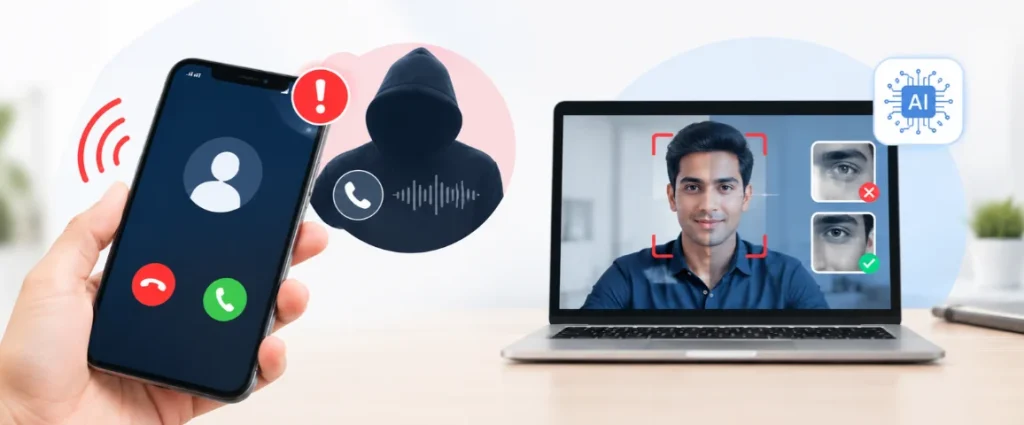
AI scams in India use cloned voices, deepfake videos and scripted fake officials to rush you into sending money. Hang up, call the person back on a number you already have, and never act on a call that demands secrecy or instant payment. If you’ve already paid, call 1930 right away.
Your phone rings. It’s your son, and he sounds terrified. He says he’s been in an accident and needs ₹50,000 now, and please don’t tell anyone.
That voice can be fake. A few seconds of audio from an Instagram reel is enough for scammers to clone it.
This guide covers how AI scams in India work, how to spot fake calls and fake videos, and what to do in the first 10 minutes if you get caught.
How common are AI scams in India?
Very. A 2025 survey by the Observer Research Foundation found that 47% of Indian adults have been hit by an AI voice or deepfake scam, or know someone who has. The global average was around 25%.
Of the Indians who got scammed by an AI voice, 83% lost money. Almost half lost more than ₹50,000.
The cybercrime helpline 1930 logged about 32 million calls in 2025, according to Moneylife. These aren’t rare events.
The 5 AI scams you’re most likely to meet
1. AI voice scams. Scammers pull a voice sample from social media, or from a “wrong number” chat with you. Then they call your family pretending to be you, or call you pretending to be a relative. The story is always an emergency, and the payment is always UPI.
2. Digital arrest calls. Someone claiming to be from the CBI, police or customs tells you you’re under “digital arrest.” They keep you on a video call and tell you not to hang up or talk to anyone. There’s no such thing as digital arrest in Indian law. No agency does this over WhatsApp or Skype.
3. Deepfake video calls. A scammer appears as your boss, a friend or a celebrity. The face moves, the voice matches, and the request is for money or an urgent “investment.”
4. Fake calls and messages with AI-written scripts. Bank KYC alerts, courier “customs” fees, job offers. AI has fixed the bad grammar that used to give these away, so they read cleanly now.
5. Fake investment videos. A famous business leader “recommends” a trading app in a video. It’s a deepfake, and the app’s dashboard is fake too.
How to identify an AI voice scam
Listen for the setup, because the voice itself can be nearly perfect.
1. Panic and secrecy. “Don’t tell Papa.” “Don’t call the police.” Real emergencies don’t come with gag orders.
2. Payment by UPI or a new account. Hospitals and police don’t ask for money on Paytm.
3. A strange number. “My phone broke, I’m using a friend’s.” Convenient.
4. No room for questions. They get angry or tearful the moment you try to verify.
5. Slightly flat delivery. Cloned voices often sound a bit robotic on long sentences, or have odd pauses and breathing.
Don’t trust your ears alone. In one widely quoted survey, most people couldn’t tell a cloned parent’s voice from the real one. Treat the story as the red flag, not the sound.
How to identify fake videos
Deepfakes are good, but live ones still slip. Look for these:
1. Mouth and speech out of sync, especially on words with “p,” “b” or “m.”
2. Blurry edges around the hairline, ears or glasses.
3. Odd blinking. Too little, or too regular.
4. Lighting that doesn’t match the room behind the person.
5. Teeth and hands that look smeared or change shape.
6. A “bad connection” excuse every time you ask for something different.
On a live call, ask the person to turn their head fully to the side, wave a hand in front of their face, or hold up today’s newspaper. Real people do it in 2 seconds. Deepfake software tends to glitch.
For videos you didn’t ask for (the celebrity trading tip, the leader endorsing an app), go to the person’s official channel. If it’s not there, it’s fake.
How to avoid online scams: 7 habits that work
1. Pick a family safe word. Something only your family knows. Ask for it on any money call.
2. Hang up and call back. Use the number saved in your phone, not the one that called you.
3. Slow down. Every scam needs speed. A 5-minute pause kills most of them.
4. Lock your social media. Set reels and videos to friends only, so strangers can’t harvest your voice.
5. Never share OTPs, PINs or Aadhaar details on a call. Banks don’t ask.
6. Check links. Government sites end in .gov.in. A “tax refund” link ending in .xyz is a scam.
7. Tell your parents. Older relatives are the most targeted, and a 10-minute chat can save them lakhs.
What to do if you’ve been scammed
Speed decides whether you get money back.
1. Call 1930 immediately. This is India’s cyber fraud helpline, and quick reports give banks the best chance to freeze the money.
2. File a complaint at cybercrime.gov.in.
3. Call your bank and ask them to block the transaction or freeze the account.
4. Save everything. Screenshots, call logs, UPI transaction IDs, phone numbers.
5. Lock your Aadhaar biometrics at uidai.gov.in if you shared your details.
Don’t feel stupid about it. These scams are built by professionals, and smart people fall for them every day.
Learn how to identify AI scams in India, spot fake calls and videos, and stay safe online with One Final Draft, a guest post platform where writers can share insights and publish informative content through Write for Us opportunities.
Frequently asked questions
What are AI scams in India?
They’re frauds that use artificial intelligence to fake voices, faces, messages or websites. Common types include voice cloning, deepfake video calls, digital arrest calls and fake investment ads.
How do I know if a call is an AI voice scam?
Look at the situation. Urgent money requests, secrecy, a new number and pressure to pay by UPI point to a scam. Hang up and call the person back on their saved number.
How can I tell if a video is a deepfake?
Check lip sync, blinking, lighting and the edges of the face. On live calls, ask the person to turn sideways or wave a hand across their face.
Is “digital arrest” real?
No. Indian law has no such thing. Real agencies don’t arrest anyone over a video call or ask for money to “clear” a case.
What’s the number to report online fraud in India?
Call 1930 or file a report at cybercrime.gov.in. Do it as fast as you can.
Can scammers really clone my voice from a reel?
Yes. A few seconds of clear audio can be enough for some tools. Keep videos private if you can
Comments are coming soon. In the meantime, share this piece with someone who should read it.