

Imagine the last time you tried on a new cafe, bought something online, or downloaded an app.
There are chances that you did not rely on the brand’s own claims. You might have checked ratings, read customer reviews, looked at the testimonials, and even asked someone you trusted. Even when customers believe that they are making independent choices, the opinion of other people can quickly influence their decisions.
This is the real power of social proof.
In simple words, social proof means that people look at the actions, choices, and opinions of others before deciding what to do. In marketing, this becomes even more important as customers are not sure whether a product, a service, or a brand is worth trusting.
This is why social proof in marketing has become an integral component of modern brand communication. It helps the brands to move beyond “we are good” and show that the real people already trust them.
What is Meant by Social Proof?
Social proof is a psychological idea where people use the behaviour of others as a guide, especially when they feel uncertain. When someone does not know what the best option is, they often assume that the people’s choices can help them decide.
This is common in everyday life situations.
For example, a crowded restaurant may look more reliable than an empty one. A product with hundreds of positive reviews may look more promising than one with no feedback. Similarly, a paid service may look more trustworthy than a paid advertisement.
In the field of marketing, social proof works because customers want reassurance. They want to know that others have tried the product, received value, and had a good experience.
This is the reason why brands use customer reviews, testimonials, ratings, case studies, user-generated content and influencer mentions to support their message.
What is the Importance of Social Proof in Marketing?
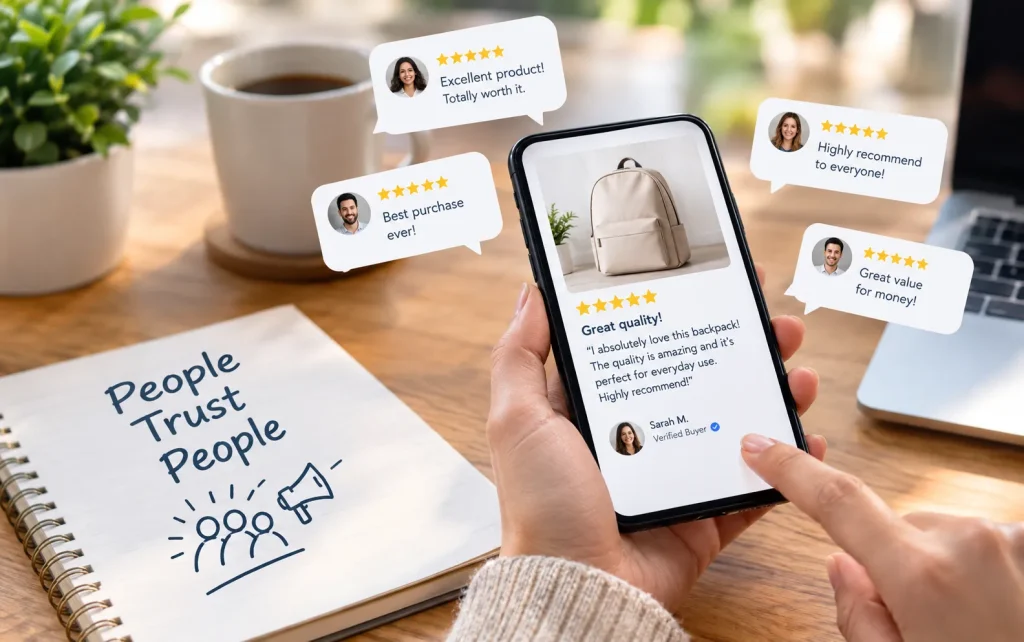
Customers of today are well-surrounded by advertisements. Every brand claims to be useful, reliable, affordable, and of high quality, and naturally, people become more aware and cautious.
Social proof is one thing that helps in reducing this hesitation.
Rather than asking the customers to believe in a brand directly, it gives them evidence from other people. This, in turn, makes the message more believable and less promotional.
According to Forbes, endorsements, reviews, and testimonials can influence how people make decisions.
For instance, a skincare brand may claim that its products help improve skin texture. That claim might attract attention, but a genuine customer review on how the product helped them over the course of six weeks can feel more convincing. This is where social marketing becomes more powerful.
It uses real customer experiences to build trust, improve confidence, and guide customer buying decisions.
How Does the Customer Review Influence Decisions?
Customer reviews are one of the most common forms of social proof. They appear on e-commerce websites, Google Business profiles, app stores, social media pages, and service platforms.
People read reviews because they are looking for honest information. They want to know what worked, what did not, and whether the product matches the brand’s promise.
A strong customer review can easily answer the questions that a product description may not cover. It can explain the delivery experience, product quality, ease of use, customer support, and long-term value.
For service-based businesses, reviews become even more important. A customer cannot always see the results before paying. In such situations, customer reviews can help in creating confidence before an inquiry or a purchase.
At the same time, reviews work the best when they feel genuine and organic. A mix of detailed, positive and honest responses from a brand feels more trustworthy compared to perfect ratings and vague comments.
Why Testimonials Help in Building Stronger Trust?

Testimonials are an important part of social proof. Compared to short reviews, testimonials generally tell a clearer story about the customer’s overall experience.
A good testimonial explains the problem, the solution and the results. It also enables potential customers to imagine their own experiences with the brand.
For instance, a business software company may use a testimonial from a client who improved team productivity after using the platform. A coaching centre may share a student testimonial explaining how the guidance helped with exam preparation.
Testimonials work the best as they add a human voice to the brand’s claims.
They are well-suited for industries where trust is important, including education, healthcare, finance, real estate, technology, and professional services.
Consumer Influence and Power of Belonging
Well, people do not make choices when they are alone. Friends, family, colleagues, online forums, and public opinion can easily shape how customers think about the brands.
This is known as consumer influence. In some cases, this influence can be direct. A friend recommends a restaurant, and you decide to visit. A colleague may praise a productivity tool, and then you decide to try it.
In some cases, this influence can be indirect. You may notice many people wearing a particular brand, using a certain app, or talking about new products online. Without anyone directly asking you to purchase, the repeated visibility creates curiosity.
This is the reason that popular products often become more famous and visible. The more people talk about them, the more others want to understand why.
People often feel more comfortable choosing something that others are already accepting, especially when the decision involves money, reputation, and personal results.
Different Types of Social Proof Marketing

Brands make use of social proof in different ways depending on their industry, audience, and marketing goals. Some of the common types of social proof marketing have been mentioned below:
| Type of Social Proof | Best Used For | Example |
|---|---|---|
| Customer Reviews | Product pages, app listings, Google profiles and e-commerce stores | A buyer sharing how a product performed after delivery |
| Testimonials | Service pages, landing pages, websites and brochures | A client explaining how a service helped solve a problem |
| Case Studies | B2B brands, agencies, software companies and consultants | A business showing how it improved results for a client |
| User-Generated Content | Fashion, food, beauty, travel, lifestyle and D2C brands | Customers posting photos, reels or stories using the product |
| Expert Endorsements | Healthcare, education, finance, wellness and technical products | An expert recommending a product or service based on experience |
| Influencer Mentions | Social media campaigns, launches and awareness campaigns | An influencer sharing a genuine product experience |
| Client Logos | B2B websites and agency portfolios | Showing brands or companies that have worked with the business |
| Media Mentions | PR pages, homepages and investor-facing pages | Featuring coverage from recognised publications |
Where Should Brands Use Social Proof?
Well, social proof should not sit on a separate testimonial page. It should also appear at important decision points across the customer journey.
Brands can use it on the following pages:
1. Homepage
2. Product pages
3. Landing pages
4. Checkout pages
5. Service pages
6. Email campaigns
7. Social media posts
8. Advertisement creatives
For instance, a landing page can include a short testimonial near the call-to-action button. While a product page can show ratings and customer reviews near the price.
Here, the goal is simple, and that is to place proof where the customer is doubtful.
How to Use Social Proof Without Overdoing It
Social proof can help in building trust, but it should be used with honesty.
Customers may lose confidence if a brand exaggerates its claims, uses fake reviews or showcases unclear results. Trust takes time to build, but it can be damaged quickly.
Therefore, brands should adhere to a few basic rules:
1. Use real customer feedback.
2. Avoid fake or overly polished reviews.
3. Keep the testimonials specific.
4. Update reviews and case studies regularly.
5. Respond professionally to negative feedback.
A good social proof does not need to shout. It should simply help the customers feel more informed and confident.
Why Does Social Proof Work So Well Online?
Online buying often involves uncertainty. Customers cannot always touch the product, meet the service provider, or completely judge the quality in advance.
However, social proof helps in reducing that uncertainty.
A buyer may not be aware of the brand personally, but seeing the experiences of the people creates a sense of safety. This is especially important for new brands that are trying to earn attention in a busy market.
Moreover, social proof also supports faster and more efficient decision-making. Rather than comparing every possible option in depth, customers often make use of reviews, ratings, and testimonials as shortcuts.
This does not mean that the customers are careless. It simply means that they are using available information and data to make a practical choice.
Wrapping Up
Social proof is powerful, as it reflects how people naturally make their own decisions. We observe, compare, and learn from the choices of others.
For brands, this makes social proofing more important than a conversion tactic. It is a way to build credibility through real customer experiences.
Customer reviews, testimonials, case studies, and user-generated content can help customers feel more confident before they buy. At the same time, brands must use them honestly and clearly.
Well, the most impactful and the strongest form of social proof is not a perfect 5-star rating or a polished testimonial. It is a real customer experience that helps someone else make a better decision.
Understand how social proof influences customer choices, builds trust, and shapes buying behaviour, with practical marketing insights and opportunities to share your ideas through Write for Us at One Final Draft.
Frequently asked questions
What is social proof in marketing?
Social proof in marketing simply means using customer actions, reviews, testimonials, and recommendations to show that other people already trust a brand, product, or service.
Why are customer reviews important?
Customer reviews can play a big role in helping potential buyers understand real experiences. They can reduce doubt, answer practical questions, and make the brand feel more trustworthy.
What is the difference between reviews and testimonials?
Reviews are short customer opinions that often come with ratings. Testimonials, on the other hand, are more detailed statements that clearly explain the customer’s problems, experience, and result.
How can brands use social proof effectively?
Brands can use social proof through reviews, testimonials, case studies, user-generated content, client logos, and real customer stories.
Comments are coming soon. In the meantime, share this piece with someone who should read it.