

The online space is packed with brands saying similar things, offering similar services, and competing for the same attention. In that kind of setting, people do not just ask, “What does this brand sell?” They also ask, “Can this brand be trusted?”
That shift is what makes the trust economy so important. Credibility has become a real business asset. It shapes whether someone clicks, buys, subscribes, recommends, or walks away. A brand may have a strong offer, but if it feels uncertain, inconsistent, or overdone, many people will hold back.
This is why building brand credibility online matters so much. It is not only about looking polished. It is about creating enough confidence that people feel comfortable choosing the brand over another option.
What the Trust Economy Means
The trust economy is a simple way of describing a market where belief carries value. In other words, brands are judged not only by what they claim, but by how believable those claims feel.
That belief is built through several things:
1. Clear communication
2. Consistent behaviour
3. Visible proof
4. Honest positioning
5. Dependable customer experiences
In the trust economy, a brand’s reputation does more than support marketing. It supports growth. When people trust a business, they spend less time second-guessing it. Data shows that 87% of consumers are willing to pay a higher price for the brand products they trust. They move more quickly, compare less aggressively, and feel more comfortable coming back.
Why Trust Has Become More Valuable Online?

The internet has made information easy to find, but not always easy to trust. People are constantly exposed to claims, promises, reviews, testimonials, and polished branding. Because of that, they have become more careful.
A brand can no longer assume that visibility alone will create confidence. People want to know:
1. Is this brand consistent?
2. Does it sound real?
3. Can it prove what it says?
4. Will it deliver what it promises?
When those answers are unclear, trust drops. When they are strong, trust rises fast.
This is especially important for online business operations, where most consumers rarely come across businesses personally before making the purchase decision.
Brand Credibility Impact on Consumer Behaviour
Brand credibility impacts consumer decision-making significantly. When there is credibility, decisions become more straightforward for consumers.
Strong brand credibility can:
1. Reduce hesitation
2. Shorten the decision-making process
3. Increase enquiry rates
4. Improve conversion
5. Encourage repeat business
It also helps people feel better about their choice. Many customers do not buy only because a product looks good. They buy because the brand feels dependable. In that sense, credibility acts like reassurance.
And it is precisely for this reason that social proof plays such an important role. All kinds of feedback mechanisms, reviews, case studies, referrals, and visible results all help to lessen any doubts that someone might have about the credibility of the brand.
What Weakens Trust Online?
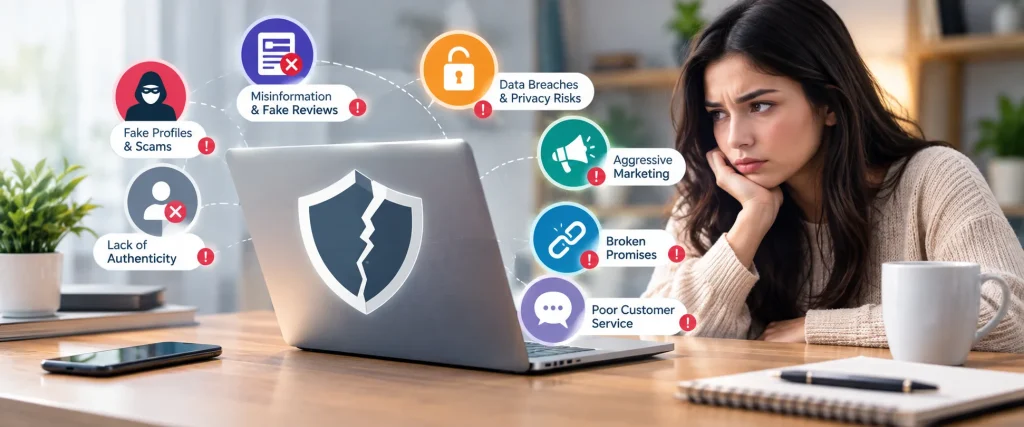
Trust is a delicate thing. The minutest things may create mistrust problems which, while small for the brand, are very important for the consumer.
Some of these include:
1. Deception by false claims
2. Hidden costs
3. Ambiguity in offers
4. Generic and outdated content
5. Late responses to customer queries
6. Lack of evidence
7. Poor and inconsistent branding
Practical Ways to Build Brand Credibility Online
Building trust online is not about one big campaign. This is about repeating signals that reinforce credibility over time.
Some of the most effective ways of building credibility include the following:
1. Messaging Clarity: The brand should be able to express itself and clearly convey its unique selling propositions. Clarity wins over creativity in gaining credibility.
2. Validation of Claims: To validate the claims for a brand, it is important to showcase client testimonials, online reviews, awards, and certifications.
3. Uniformity in Brand Voice: The tone and voice of the brand should be consistent across all channels to build brand authenticity online.
4. Specificity: Generality may lend credibility, but specificity enhances communication effectiveness.
5. Reliability: The credibility of the brand involves delivering and keeping promises; therefore, it is not enough to impress the customers with general claims.
6. Customer experience as a component of brand identity: Timeliness, responsiveness, and accountability ensure the credibility of the brand.
These steps may seem simple, but together they create a strong foundation. That is what building brand credibility online really looks like in practice.
The Business Value of Trust
Trust is not only emotional. It has commercial value.
When a brand is trusted, it often benefits in ways that go beyond one sale:
1. Customers return more often
2. Referrals become easier
3. Pricing feels more justified
4. Sales conversations become smoother
5. Loyalty grows more naturally
This is why the trust economy matters so much. Credibility can reduce acquisition friction and improve retention at the same time. It can also make a brand more resilient when competition increases or the market feels uncertain.
In many cases, trust becomes the reason a customer chooses one brand over another that looks almost identical on paper.
Trust as a Long-term Growth Asset

Short-term attention can be bought. Trust has to be earned.
That is what makes it such a valuable growth asset. A brand that invests in credibility builds something that supports future marketing, future sales, and future customer relationships. It creates a base of confidence that makes every other effort more effective.
Strong credibility also helps a brand endure. Trends change. Platforms change. Campaigns end. But trust, once established, can keep supporting the business long after a single promotion has finished.
That is why brand authenticity and building brand credibility online should not be treated as side tasks. They are part of the brand’s long-term strategy.
Conclusion: Credibility is the New Currency
In the trust economy, attention alone is not enough. People want reasons to believe. They want proof, consistency, and honesty. They want brands that feel real.
That is why credibility has become the new currency. It shapes trust, and trust shapes growth. Brands that understand this do more than market themselves well. They build relationships that last.
And in a digital space full of noise, that kind of belief is worth a great deal.
Stay ahead with fresh insights on business, technology, AI, startups, and finance, and explore new opportunities to share your expertise through the Write for Us section at One Final Draft.
Comments are coming soon. In the meantime, share this piece with someone who should read it.